Permanent Buddhism: Mark Hay’s article on Culturally-sensitive Buddhist Tattoos

hays tattoo.png

A few days ago, a friend let me know that freelance writer Mark Hay’s piece in Tricycle Magazine about his years-long journey to get an appropriate-and-non-appropriative Buddhist tattoo had come out. Hay interviewed me as part of the piece, and I see that I get more than one mention in the final cut. Thankfully, I’m not paraphrased too awkwardly, and Mark gives a good overview of some of the issues at stake with getting tattoos that involve very culturally-specific imagery or contexts. Continue reading →

“You Can’t Watch Pornos in the Monastery”: Tibetan Tantra, Imagined Pleasure, and the Virtuality of Desire

look smile.jpg

(Non-Tibetan Buddhist monks, ‘just watching’)

In my previous post on the life of 18th century monk turned non-celibate sexual-yogi Lelung Jedrung Zhepai Dorje, I noted how historically, debates in Tibet about the practice of tantric Buddhism have often revolved around whether or not practitioners should implement instructions and embody imagery included in the Highest Yoga Tantras ‘in the flesh’ or in more figurative or symbolic ways ‘in the imagination’. In the post, I proposed that some Western neo-tantric practitioners had perhaps projected overly rigid distinctions of ‘symbolic/actual’ onto indigenous tantric phenomena. I pointed out how in native Tibetan contexts, the lines between ‘actual’ and ‘imaginary’ in tantric practice could be quite blurry. Continue reading →

Tantric Sex Partners, Actual and ‘Imagined’: Tibetan Karmamudra, and the Life and Times of Lelung Jedrung Zhepai Dorje

lelung shepe dorje

(The Great Fifth Lelung Jedrung Rinpoche, Zhepai Dorje)

Recently, Tibetan scholar, traditional physician and yogi Dr Nyida Chenaktsang told me about (and gave me permission to read) a short text by the 18th century Tibetan yogi and visionary saint or ‘treasure revealer’, Lelung Jedrung Zhepai Dorje (sle lung rje drung bzhad pa’i rdo rje, 1697-1740). This saint, whose name means something like ‘the Jedrung reincanation, the laughing/proclaiming tantric thunderbolt, or non-dual reality from the Lelung region’, is also known by the personal names Trinlay Wangpo and Lobsang Trinlay. He was born in Ölga/Ölkha, a region in Lhoka in South-Western Tibet, and was recognized as the Fifth Jedrung Rinpoche – that is to say, as the reincarnation of Drubchen Namkha Gyaltsen (1326-1401), the celebrated master who was one of Je Tsongkhapa (1357-1419), the founder of the Gelukpa lineage’s, principal gurus. Yet, despite being the re-embodiment of a celibate master – of one who played mentor to boot to a figure strongly associated with the monastic regulation and circumscription of tantra in Tibet, AND despite the fact that Lelung Zhepai Dorje had himself received monk’s ordination from the Sixth Dalai Lama at the age of seven, the text that Dr Nyida brought to my attention has nothing to do with either vows of celibacy or monasticism. Continue reading →

‘His Weight in Gold’: Women of Power in Game of Thrones and Tibetan Buddhism (*SPOILERS!)

melisandre

FOR THE INTERNET IS DARK AND FULL OF SPOILERS! GAME OF THRONES AND TIBETAN BUDDDHIST SPOILERS AHEAD FOR THOSE WHO HAVE NOT WATCHED THE MOST RECENT EPISODE OF THE SERIES OR HAVE NOT ACHIEVED ENLIGHTENMENT!

Last week’s episode of Game of Thrones, the second in this current season, saw fans’ questions about whether we’d be seeing more of a moving version of the Lord Commander of the Night’s Watch Jon Snow put to rest. Continue reading →

Tibetan ‘Yogi-Doctors’ Today: Professor Gojo Wangdu’s Preface to Dr Nida’s new book on Mantra Healing

image1 (7)

The following is a translation of Professor Gojo Wangdu’s preface to Dr Nida Chenagtsang’s new Tibetan-language volume on the ‘Interdependent/Auspicious Science of Mantra Healing’. In his preface, the Professor supplies a brief overview of Dr Nida’s upbringing, education, and achievements. He describes the important contributions that Dr Nida has made to re-invigorating Tibetan traditional medicine, like his efforts to preserve and revive lapsed oral lineage practices such as the ‘stick-therapy’ methods that were taught by Padampa Sangye and others centuries ago. The Professor makes a strong case for why Tibetan doctors today should practice as the founding lineage masters of Tibetan traditional medicine did, as ‘yogi or ngakpa doctors’, that is, as practitioners who seamlessly integrate mantra healing rituals, yogic practice, and medicine. He also responds to questions readers might have about the issue of secrecy, and of the pre-requisites – the transmissions and training – required to put mantra healing into practice to benefit beings. While the Professor follows the traditional Tibetan style of modestly talking-down his own achievements, he is a highly respected and learned scholar, and his endorsement of Dr Nida’s book speaks to its value.

Continue reading →

De-calcifying your Pineal Gland, and other New Age Literalisms

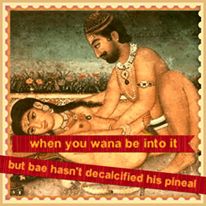
“It’s not you…I just don’t think our pineal glands are in the same place right now.”#NewAgeDatingProblems

A while back, I was kinda bored and for reasons I still don’t fully understand, I made this meme. I thought it came out quite well.

decalcifying your pineal gland.jpg

I was just going to post this meme here, but then it got me thinking. Jokes aside, I find the idea of doing something like ‘de-calcifying your pineal gland’ quite fascinating. The concept is one of a panoply of New Age lifestyle/purificatory options, which rely at least in part on a veneer of scienc-i-ness for their legitimacy. Continue reading →

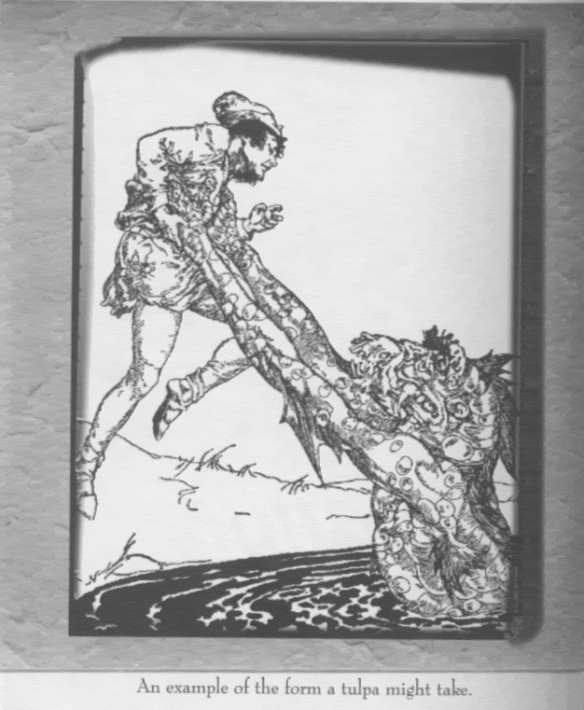
Paranormalizing the Popular through the Tibetan Tulpa: Or what the next Dalai Lama, the X Files, and Affect Theory (might) have in common

fua.gif

This most recent essay of mine on Savage Minds also took place as part of a running conversation with popular media and representations. I think that it does a decent job of re-iterating and extending some of the ideas that came up in the Tibetan aliens and singing bowl essays about the sometimes bewildering cross-fertilizations between Indo-Tibetan esotericisms, Western occultism, and popular culture.

There’s a lot more to be said in all this about Continue reading →

Secrets of the Sex Magic Space Lamas Revealed! Tibetan Buddhist Aliens and Religious Syncretism

tibetan aliens

This was probably my favourite of the four October essays to write, probably because it involved so many things that I love to think and talk about, but was also something I never, ever imagined I’d be writing for an anthropological audience, or maybe at all.

Years ago I was warned by a lovely acting HoD in an anthropology department to be careful of pursuing the study of esotericism Continue reading →

Tantra and Transparency, or Cultural Contradictions and Today’s Tibetan Buddhist Wizard

white-and-red-robes.jpg

Here’s my second piece for Savage Minds, and the first of the four-part guest-blogger series I did during October last year.

This essay offers a brief overview of my current dissertation research project on ngakpa and ngakpa lineages in exile and outside of Tibet. I tried to make this piece a useful summary of some of the dimensions of ngakpa/ma histories, orientations, practices, and lineages that I thought were of interest, especially for an anthropological audience perhaps less familiar with Tibetan societies and Vajrayana. Continue reading →

Everything is fake in China: Treasure-revealers, False Prophets, and the Miracle of Community Belief

fake terton post

(Not sure why this picture is so small, but hopefully at the top you can see some of the photos of the allegedly fake Golok terton Drolma Thar, on the bottom left, Pema Lingpa, and on the bottom right a pensive Jesus Christ)

Tertön གཏེར་སྟོན་ or ‘treasure revealers’ are visionary prophets or saints in Tibetan Buddhist tradition. They are understood to be reincarnations of the original disciples of Padmasambhava or Guru Rinpoche, the Indian tantric master or ‘Second Buddha’ who established Buddhism in Tibet. Before he dissolved his 8th century physical form, Guru Rinpoche is said to have hidden various ‘treasures’ or terma གཏེར་མ་ all over Tibet and the Himalayas, with the intention that these treasures would be discovered by appointed persons at a later date. Guru Rinpoche left various treasures for safekeeping with guardian spirits in the sky, under the earth, in rocks and caves, and in the mind-streams of his closest disciples. Centuries after his time and into the present, certain individuals have claimed to have had powerful visionary experiences and past-life memories which have convinced them and others that they are reincarnations of Guru Rinpoche’s elect. Attending to these visions, insights, and memories, these individuals have been able to follow the clues to unearth treasures left specially for them across space and time by Guru Rinpoche and his partner the great female Buddha and queen Yeshe Tsogyal. Continue reading →