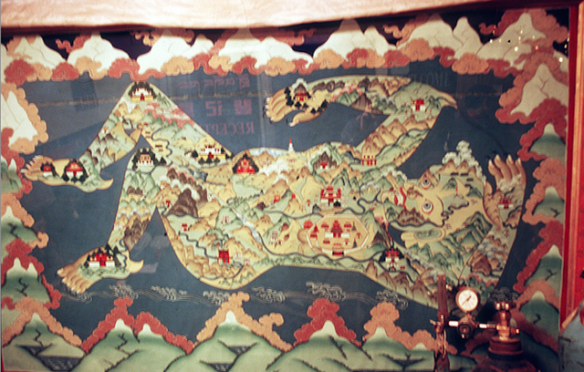
My Mother was a Rock-ogress Yeti Monster: True Tales of Dharma, Demons, and Darwin

srin mo.png

Despite the ridiculous title, I get the feeling this next Savage Minds essay was a little less widely read. This may have something to do with the fact that the technicalities of Tibetan exile secularism and school curricula have less of a wide appeal than some of the other subjects I’ve covered. Whatever the case, I think that this particular Tibetan origin myth Continue reading →

Tantra and Transparency, or Cultural Contradictions and Today’s Tibetan Buddhist Wizard

white-and-red-robes.jpg

Here’s my second piece for Savage Minds, and the first of the four-part guest-blogger series I did during October last year.

This essay offers a brief overview of my current dissertation research project on ngakpa and ngakpa lineages in exile and outside of Tibet. I tried to make this piece a useful summary of some of the dimensions of ngakpa/ma histories, orientations, practices, and lineages that I thought were of interest, especially for an anthropological audience perhaps less familiar with Tibetan societies and Vajrayana. Continue reading →

Angry White Buddhists and the Dalai Lama: Appropriation and Politics in the Globalization of Tibetan Buddhism

voldemort.jpg

Since I’m just now launching this blog, I thought I would re-post links to my earlier Savage Minds blog essays for readers, with some additional comments.

This is the first piece I put out on the Savage Minds blog, and deals with the controversial Western Buddhist organization, the New Kadampa Tradition (NKT). This was a modest piece on my part. Continue reading →

The Social Life of Magic: Memories of Hoodoo in Detroit


In occult ‘scenes’ you find a lot of people identifying as magicians. Of course, this makes sense: if you do magical rituals, especially if you do them professionally for clients, then why not call yourself the rusty, graveyard dirt-smeared spade that you are?

Still, discussions about self-identifying as a contemporary practitioner of magic and the supposed implications of this, can potentially distract from the fact that magic isn’t just something people say they do or are, it’s something that merely exists as part of the everyday rhythms of many people’s lives, and that’s ok. In a beautiful piece, Kenya Coviak reminisces about growing up in Detroit and reflects on the ways that Hoodoo was literally a part of the scenery, furniture, and foundations of her daily life.

Continue reading →

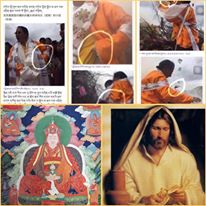
Everything is fake in China: Treasure-revealers, False Prophets, and the Miracle of Community Belief

fake terton post

(Not sure why this picture is so small, but hopefully at the top you can see some of the photos of the allegedly fake Golok terton Drolma Thar, on the bottom left, Pema Lingpa, and on the bottom right a pensive Jesus Christ)

Tertön གཏེར་སྟོན་ or ‘treasure revealers’ are visionary prophets or saints in Tibetan Buddhist tradition. They are understood to be reincarnations of the original disciples of Padmasambhava or Guru Rinpoche, the Indian tantric master or ‘Second Buddha’ who established Buddhism in Tibet. Before he dissolved his 8th century physical form, Guru Rinpoche is said to have hidden various ‘treasures’ or terma གཏེར་མ་ all over Tibet and the Himalayas, with the intention that these treasures would be discovered by appointed persons at a later date. Guru Rinpoche left various treasures for safekeeping with guardian spirits in the sky, under the earth, in rocks and caves, and in the mind-streams of his closest disciples. Centuries after his time and into the present, certain individuals have claimed to have had powerful visionary experiences and past-life memories which have convinced them and others that they are reincarnations of Guru Rinpoche’s elect. Attending to these visions, insights, and memories, these individuals have been able to follow the clues to unearth treasures left specially for them across space and time by Guru Rinpoche and his partner the great female Buddha and queen Yeshe Tsogyal. Continue reading →

Heroic Tibetan Man-buns on Ngakpa Update

David Chapman who runs the Ngakpa Update site asked to share my earlier post about Justin Bieber, dreadlocks and Tibetan tantric practitioners on his blog. The post includes a translated excerpt from an extensive Tibetan language essay by Dr Nida Chenagtsang, which offers comprehensive and clear details about Tibetan tantric specialists’ traditional styles of dress.

David collects a lot of really useful news and links connected to ngakpa practices and lineages on the page Continue reading →

Retiring the Gods? Tibetan Democracy in Exile and Alternative Modernities

retiring the gods post

(I originally made the following post on my Facebook page on April 7th. I reproduce it here, along with some clarifications and further reflections at the end. This picture collage shows the Nechung kuten in trance at the top, the Tsering Chenga goddesses possessing their medium on the bottom left, and Security and Welfare minister Mr Ngodup Drongchung is on the right, during an interview with Tibetan exile media immediately following his resignation)

Tibetan social media and exile society have been alive of late with commentary about the recent pronouncements and actions made by some of the Tibetan state oracles here in India. The state oracles, who are known in Tibetan as ཆོས་སྐྱོང ༼chökyong༽ or བསྟན་སྲུང་ ༼tensoong༽, i.e. ‘dharma-protectors’, are powerful and ferocious spirits – supernatural bouncers or ‘fixers’ – who are oath-bound to serve the Dalai Lama, the Tibetan government and the Tibetan people by providing prophetic advice on religious issues and affairs of state. Continue reading →

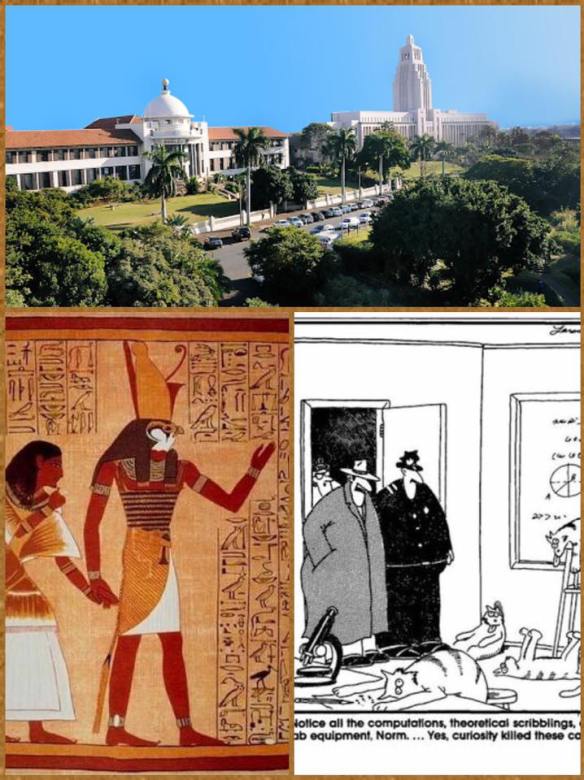
Learning Hierogylphics and Academic Mentors

learning hieroglyphics

I started asking myself the other morning if I could remember when I really felt like I was going to become an academic. I was a precocious child – I was passionate from a young age about reading and learning, about conducting my own research into specialized subjects that interested me. But I found myself thinking just now about when exactly the point of no return might have been.

I am the son of a (now semi-retired) professional academic. When I was growing up, I would often visit my Dad’s office in the English Department at the University of KwaZulu Natal in Durban, South Africa. My Dad worked for many decades as a professor there, and the university looms large in the city and my snap-shot memories of it. It is a tall, tan building that looks down somewhat imperiously onto the city from atop a small hill. Pushing up from the folds of land surrounding it, it exudes a quiet constancy. Yet despite its classic monastic-fortress on the hill feel, any firmness it might manage is ultimately lost to Durban’s humid haze, and the city’s trademark red sand has coated the building’s stonework altogether too thoroughly for it to maintain any illusion of celestial stateliness – ruddy-cheeked and dusty, the university’s brand of monasticism is less regal abbot, and more older, disheveled but dignified bachelor – tall, skinny and off to one side, a friend of the hosts at the mixer, pulling nervously at his collar. Continue reading →

Justin Bieber, Heroic Man-buns and the Relative Meaning (and Meaninglessness) of Dreadlocks

Dreadlocks post

Debates about hairstyles, fashion, identity and culture have been in the news in the last few days. After posting pictures of his new blond dreadlocks, pop star Justin Bieber was roundly criticized for cultural appropriation – for capitalizing on a cultural aesthetic that in the US is historically associated with black histories, identities, and struggles. Commentators noted that while people/celebrities of colour in the US have been routinely criminalized or villianized for sporting a hairstyle connected to their history and experiences as minorities, when Bieber as a white person casually took on this style as his own it came with none of the meaning, and context, and also none of the backlash. Continue reading →

Bee Careful what Ewe Wish Four: Monks behaving badly and Grammar-nazi Genies

dop dop post

Tibetan can be a confusing language – not least because it isn’t really one language at all. There’s still no standardized form of either written or spoken Tibetan, even if there have been attempts to produce them, and when it comes to the spoken language there are many, many registers and regional variations of both grammar, syntax, pronunciation and vocabulary. Tibetan language(s) is/are also notoriously filled with homophones and homonyms – like French, many Tibetan dialects have a lot of ‘silent’ or almost silent letters, and words that are spelled quite differently on paper may sound very similar to each other depending on one’s regional accent. The same word, either in its written or spoken incarnation, may have various meanings, depending on the context. The following story demonstrates just how dangerous language ambiguity can be. Continue reading →