My Mother was a Rock-ogress Yeti Monster: True Tales of Dharma, Demons, and Darwin

srin mo.png

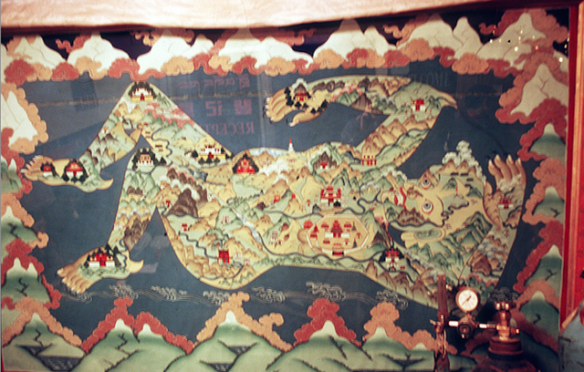
Despite the ridiculous title, I get the feeling this next Savage Minds essay was a little less widely read. This may have something to do with the fact that the technicalities of Tibetan exile secularism and school curricula have less of a wide appeal than some of the other subjects I’ve covered. Whatever the case, I think that this particular Tibetan origin myth Continue reading →

Tantra and Transparency, or Cultural Contradictions and Today’s Tibetan Buddhist Wizard

white-and-red-robes.jpg

Here’s my second piece for Savage Minds, and the first of the four-part guest-blogger series I did during October last year.

This essay offers a brief overview of my current dissertation research project on ngakpa and ngakpa lineages in exile and outside of Tibet. I tried to make this piece a useful summary of some of the dimensions of ngakpa/ma histories, orientations, practices, and lineages that I thought were of interest, especially for an anthropological audience perhaps less familiar with Tibetan societies and Vajrayana. Continue reading →

Everything is fake in China: Treasure-revealers, False Prophets, and the Miracle of Community Belief

fake terton post

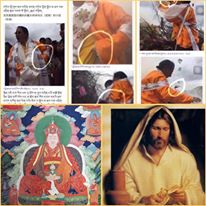
(Not sure why this picture is so small, but hopefully at the top you can see some of the photos of the allegedly fake Golok terton Drolma Thar, on the bottom left, Pema Lingpa, and on the bottom right a pensive Jesus Christ)

Tertön གཏེར་སྟོན་ or ‘treasure revealers’ are visionary prophets or saints in Tibetan Buddhist tradition. They are understood to be reincarnations of the original disciples of Padmasambhava or Guru Rinpoche, the Indian tantric master or ‘Second Buddha’ who established Buddhism in Tibet. Before he dissolved his 8th century physical form, Guru Rinpoche is said to have hidden various ‘treasures’ or terma གཏེར་མ་ all over Tibet and the Himalayas, with the intention that these treasures would be discovered by appointed persons at a later date. Guru Rinpoche left various treasures for safekeeping with guardian spirits in the sky, under the earth, in rocks and caves, and in the mind-streams of his closest disciples. Centuries after his time and into the present, certain individuals have claimed to have had powerful visionary experiences and past-life memories which have convinced them and others that they are reincarnations of Guru Rinpoche’s elect. Attending to these visions, insights, and memories, these individuals have been able to follow the clues to unearth treasures left specially for them across space and time by Guru Rinpoche and his partner the great female Buddha and queen Yeshe Tsogyal. Continue reading →

Heroic Tibetan Man-buns on Ngakpa Update

David Chapman who runs the Ngakpa Update site asked to share my earlier post about Justin Bieber, dreadlocks and Tibetan tantric practitioners on his blog. The post includes a translated excerpt from an extensive Tibetan language essay by Dr Nida Chenagtsang, which offers comprehensive and clear details about Tibetan tantric specialists’ traditional styles of dress.

David collects a lot of really useful news and links connected to ngakpa practices and lineages on the page Continue reading →

Justin Bieber, Heroic Man-buns and the Relative Meaning (and Meaninglessness) of Dreadlocks

Dreadlocks post

Debates about hairstyles, fashion, identity and culture have been in the news in the last few days. After posting pictures of his new blond dreadlocks, pop star Justin Bieber was roundly criticized for cultural appropriation – for capitalizing on a cultural aesthetic that in the US is historically associated with black histories, identities, and struggles. Commentators noted that while people/celebrities of colour in the US have been routinely criminalized or villianized for sporting a hairstyle connected to their history and experiences as minorities, when Bieber as a white person casually took on this style as his own it came with none of the meaning, and context, and also none of the backlash. Continue reading →

Reaching the Rainbow with your feet on the Ground: An Essay on the Importance and Special Characteristics of the Yuthok Nyingthik

yuthok nyingthik post

Like all other Buddhist traditions, Vajrayana or tantric Buddhism offers a way out of the terrifying and bewildering morass of human suffering and habitude that is shorthanded as Samsara (འཁོར་བ་ khorwa in Tibetan, or ‘wandering around and around’). What stands out about the tantric path of liberation from suffering, though, is that rather than insisting that we completely reject  or avoid the perceptions and experiences that can easily mire us in suffering, Vajrayana proposes that the quickest and most convenient way out is through.

In my anthropological research on ngakpa/ma, I have written about how Vajrayana provides a unique philosophical framework for thinking about (and experiencing) the relationship between different levels of reality, the ultimate and the relative, inner and outer, mundane and extraordinary, subtle and gross. A large part of what makes tantra interesting is the way in which it plays with, and attempts to resolve the contrasts between more or less subtle levels of perception and activity, between what anthropologist of Buddhism Melford Spiro long ago called ‘nirvanic, karmic, and apotropaic’ levels of Buddhist philosophy and practice (that is, the goal of ultimate liberation, improved karma for better rebirth, and a focus on the conditions of this life here and now, respectively). While the ultimate or ‘extraordinary’ ‘super-power’ in Vajrayana is Buddhahood, tantric experts can (and should) develop all kinds of other abilities along the way so as to help beings. Ngakpa/ma are distinct for how they cultivate the highest view and attainments while apparently remaining firmly grounded in the midst of ‘worldly’ life and its everyday contingencies. Ngakpa/mas double up as both master-meditator yogis cultivating spiritual attainments in retreat at a remove from worldly obligations, and as fully-engaged householders who apply their expertise and the power of their attainments to the needs and problems of their own and others’ daily lives.

Continue reading →

Mantra Healing is an Indispensable Branch of Tibetan Traditional Medicine

mantra healing indispensable

(An image of a tantric practitioner providing a life-enhancing empowerment to a patient, from the medical paintings commissioned by Desi Sangye Gyatso, 1653-1705, to accompany his commentaries of the root-tantras of the Tibetan medical tradition)

One of the first things that someone visiting Tibetan communities tends to encounter -whether they’re a foreign visitor or a transmigrating Tibetan baby – is mantras. These set-apart forms of speech, made up of specific patterns of sacred and largely untranslatable phrases and syllables, are performed with special kinds of cadence and affect which distinguish them from other sorts of utterance.

As their Sanskrit etymology suggests, mantras are ‘instruments of the mind’; holding awareness firm they help to generate various effects and qualities in the one who recites them. While many mantras are the specific sound-embodiment of deities and Buddha-beings, others are more action-based and ‘worldly’, and exist as powerful spells that in the hands of trained experts who have properly ‘activated’ them are supposed to be able to produce all kinds of results.

Many people today are familiar with Indo-Tibetan mantras but are perhaps less familiar with where exactly mantras come from. Below I have attached my very rough and inadequate translation of the first part of a three-part Tibetan blog-post which appeared on a website about Tibetan culture in 2013 (cf here). This essay which was written by Dr Nida Chenagtsang some years ago in Lhasa (and which someone called Rinchen shared independently on the website above) essay discusses the history of the use of mantras for healing (སྔགས་བཅོས་ཐབས་ ngakchö tuhp) in Tibet. Dr Nida stresses that notwithstanding Sowa Rigpa or Tibetan medicine’s investment in strongly ’empirical’ and ‘secular’ therapeutic methods, mantra healing is nonetheless an indispensable element of Tibetan medical history and practice. His piece also acknowledges that healing mantras are not unique to Buddhism, and thus shows how magic and ritual healing are areas of Tibetan cultural life which are uniquely hybrid and non-sectarian and which perhaps span beyond Buddhist hegemonies. In general, mantra healing points to a rich and complex field of history and practice, one that comprises both elite and everyday ‘folk’ actors and knowledge systems, which intertwine in fascinating ways.

Anyway, here’s the translation: Continue reading →

“Doctor, there’s a Demon in my Drink!” Tibetan Grimoires and the Tibetan Medical Tradition


guru rinpoche beer spell tibetan grimoires

Padmasambhava (pictured above), the mythic tantric saint who ensured the flourishing of Buddhism in Tibet in the 8th century was both a fully realized being and a consummate sorcerer. He is credited with having tamed the unruly indigenous demons of Tibet and having helped establish the first Buddhist monastery on Tibetan soil. As Tibet’s ‘Second Buddha’ his cultural importance to Tibetans is hard to over-emphasize. This Lotus-Born Precious guru is the quintessential model for the non-celibate tantric practitioner or ngakpa. As a realized Buddha he is the practitioner’s own basic, pure and perfect nature, as a historical and cosmological figure he represents the model practitioner of the path of tantric Buddhism, the Secret Mantra Vehicle. In his dress, comportment, practices, activities, teachings, motivation, and view he embodies everything that the best tantric practitioner should be.

It is thus no surprise that Padmasambhava’s legendary activities should feature strongly in Tibetan magic. Compared to their counterparts in Western esotericism, Tibetan medico-magical practices, and Tibetan grimoires (ngak ki beubum, སྔགས་ཀྱི་བེའུ་བུམ) have received relatively little scholarly attention. This paucity of scholarly interest is perhaps exacerbated by the fact that the more spiritual dimensions of Sowa Rigpa, or Traditional Tibetan Medicine (TTM) have been formally excised from state-sponsored Sowa Rigpa curricula in contemporary China. Continue reading →

So, You Want to be a Tantric Wizard, Huh?

so you want to be a tantric wizard


Part of my current PhD research focuses on the overlaps – and divergences – between ideas about what practicing tantra means in ‘traditional’ or ‘indigenous’ Asian contexts and in what can be called ‘neo’ or ‘New Age’ tantric settings.

Recently, I’ve been coming across a great number of (white) people who describe themselves as ‘Tantrikas’ and ‘Dakinis’, traditional terms for somebody following the path of (an often but not always non-celibate) tantric practitioner and vow-holder. The (often, but not always) white people who use these terms most liberally frequently seem to be operating well outside of the boundaries of traditional Indian or Tibetan tantra, that is, the native religious system of someone like His Holiness the Dalai Lama. As an anthropologist, I’m not interested in categorically dismissing or merely debunking these white self-avowed tantric masters and goddesses Continue reading →

Buddhist Bromance and Homoerotic Hermits: Queer Sociality as an Obstacle to Spiritual Attainment

jewel neck

I was recently looking through the Jataka Tales, that sizable collection of fables about the previous incarnations of the Buddha and his close disciples, when I came across one story, called ‘Jewel-Throat’, which you could call a queer, Buddhist version of ‘The Little Mermaid’. In this story about the relationship between a naga or snake-spirit king and two ascetic brothers, homoeroticism and homosexual love appear incidentally as obstacles to ascetic attainment. The story’s vivid account of homosexual spirit-love with reptile-people raises a number of points. Continue reading →