‘The Man with the Turquoise Roof’: Spirits as Patients and how the Father of Tibetan Medicine got his Name

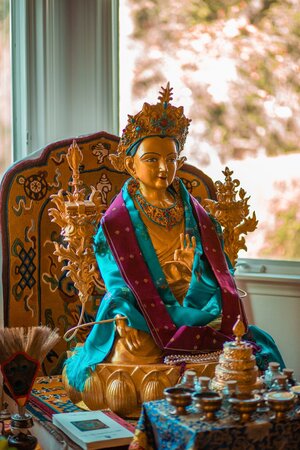
The statue of Yuthok the Younger at Yuthok Ling temple at Pure Land Farms, Topanga.

The Tibetan physician and tantric yogi Yuthok Yönten Gönpo is one of the most important figures in the history of Tibetan medicine or Sowa Rigpa, ‘The Science of Healing’ (Yuthok is pronounced a bit like the English words ‘you’ tock’. The th represents aspiration rather than a dipthong, so you should use a breathy tah sound as in the English word ‘top’, rather than a th sound like in ‘thought’ or ‘these’!). Born in or around 1126 in Western Tibet, Yuthok is one of Sowa Rigpa’s chief systematizers. He is widely regarded as the author of the Gyü Zhi or ‘Four Medical Tantras’, the four-volume Tibetan-language medical textbook which still holds pride of place in Tibetan medical curricula today. Yuthok’s influence on the history of Tibetan medicine is pervasive, so pervasive that there are two of him. Two key figures in Sowa Rigpa history share the name Yuthok Yönten Gönpo. The eleventh century Yuthok pictured above is referred to as Yuthok Sarma or ‘Yuthok the Younger’. Yuthok Nyingma or ‘Yuthok the Elder’, on the other hand, refers to a different hereditary doctor from the eighth century, who is said to be the biological ancestor of Yuthok the Younger. Yuthok the Younger is also understood to be Yuthok the Elder’s reincarnation. There is a close connection between these two figures and their life-stories often blur considerably. Both Yuthok the Younger and Elder are celebrated for their accomplishments in medicine and meditation. Both are remembered as having been consummate ngak-men or ‘tantric yogi-doctors’: individuals equally trained in medical science and tantric yoga and ritual. The biographies of both Yuthoks are hagiographies – in both his younger and older incarnation, Yuthok appears as both a highly-skilled physician and as a highly realized siddha, a tantric saint or adept capable of reading minds and performing miracles. Both Yuthoks are said to have achieved the ‘Rainbow Body’, to have dissolved into light upon their death.
Continue reading

No More Metaphors: Milarepa’s Teaching to a Ngakpa about the Magic of True Siddhas

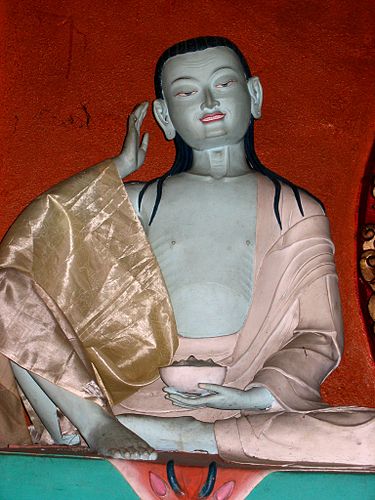
A statue of Milarepa, in his characteristic green colour, from Helambu, Nepal, and Wikipedia.

I was recently reading through Tsangnyön Heruka’s 15th century (1488 to be exact) biography of the celebrated 11th century Tibetan yogi and cultural hero Milarepa. Tsangnyön Heruka – the ‘crazy tantric yogi from Tsang’ (1452 – 1507) – reorganized and codified Milarepa’s biography from various sources, and separated this out from Milarepa’s མགུར་འབུམ་ gurbum or compendium of spiritual teaching songs. Gur is a Buddhist/tantric textual genre for which Milarepa is most famous, and refers to songs or poems which accomplished spiritual adepts are said to compose on the spot to convey in musical and poetic form key spiritual truths for audiences.

While perusing Tsangnyön Heruka’s collection of Milarepa’s songs I came across a narrative which he calls སྔགས་པའི་ཞུས་ལན་གྱི་སྐོར་ ‘Concerning Questions-and-Answers with a Ngakpa’. Readers here will probably know that my doctoral research as a cultural anthropologist was focused on Tibetan Buddhist ngakpa, or non-celibate, non-monastic tantric householders and sorcerers. I find Milarepa’s exchange with this unnamed ngakpa quite beautiful and interesting, so I thought I would share my own translation of it here. Garma C.C. Chang translated this song into English in the 60s in his ‘The Hundred Thousand Songs of Milarepa’ (Vol. 2). I’ve reproduced his translation at the end of this post. While it has many lovely qualities, I feel that it doesn’t quite capture the thrust of some of Milarepa’s responses, which I’d like draw out more here. The gist of the short narrative is that an unnamed ngakpa from དབུས་ཕྱོགས་ Üchok, Wüchok, the region of Central Tibet, comes one day to have an audience with Milarepa. Milarepa’s yogi disciple Seban Repa asks this ngakpa what type of གྲུབ་ཐོབ་ druptop or siddhas there are where he’s from. Siddhas – literally ‘spiritually accomplished ones’, people with spiritual attainments – are yogis who have achieved various spiritual powers, ranging from mastery of psychic and healing abilities, magical powers, to meditative attainment and complete Buddhahood. Seban Repa’s opening salvo is effectively, ‘How powerful/realized are your yogis and sorcerers back home, yogi-sorcerer?’ The visiting ngakpa explains that the siddhas in his region are of such calibre that they are served or waited upon by non-human beings. It is at this point that Milarepa chimes in with a provocation:

Continue reading

Illuminating the Truth: Mipam Rinpoche’s Butter Lamp Divination Instructions

A single burning marmé མར་མེ or Tibetan butter lamp. Photo courtesy of Chris Fynn – Own work, CC BY-SA 3.0, https://commons.wikimedia.org/w/index.php?curid=9427366.

I haven’t posted any translations or blah blahs on here for quite some time. The twenty-somethings in my life seem to view maintaining a blog with the same blend of emotions that I’d view someone who still owned and regularly fed a Tamagotchi. But since I’m not ready for shortform video formats and don’t see myself going for a Podcast-Patreon combo right now, here I am again, punching at my keyboard and making words on WordPress. Maybe some of you will read them. Maybe blogs will soon be cool again along with Tamagotchis and everything else from the late 90s and early 2000s. Who can say? At any rate, I have a bunch of half-finished posts to share, so I thought I’d try to build momentum again by ignoring all of those and sharing a translation I made of a Tibetan text on butter lamp divination I came across instead.

I’ve written about divination here before (see my post on Tibetan prayer-bead divination, knuckle bone divination, and this post on Somali geomancy, for example) and it’s honestly one of my favourite topics to talk and think about (I would say that divination is also one of my favourite things to do as well but that’s more complicated. I love the art of divination and I’ve been doing it for a long time, since before I hit puberty or started cooking my own meals. Divinatory procedures never cease to thrill and amaze me. Studying and practicing divination is a big passion. Even so, the divinatory process and encounter is still something I approach with trepidation, are things that remain strange and fraught to me. I try not to enter into divination lightly – as happy as I am when readings can help clients gain confidence, clarity, and navigate life better, I still approach them with a certain amount of trepidation. I am awed by how accurate and insightful divinatory processes can be but I am also troubled by the potential misuse of divination and am aware of the great responsibility involved in making use of it as a form of prediction and pastoral care. So, ‘enjoy’ is a bit misrepresentative. Maybe appreciate is better).

Anyway, with that preamble, let’s get into the butter lamp divination text which I’ve translated below. This text, which has no formal title, is one of several texts on interpreting signs and omens which appears in the sungbum གསུང་འབུམ or collected works of Ju Mipam Rinpoche, a.k.a. Jamyang Namgyel Gyatso (1846 – 1912).

Continue reading

Mirroring the Master: Making Magic in a Nineteenth Century Tibetan Book of Spells

Recently, a Facebook friend of mine shared an article from the popular anthropology blog Sapiens in the Folk Necromancy Facebook group that I co-moderate. This article, true to its title, sought to argue that AI (Artificial Intelligence) was similar to ‘magic’, at least in certain respects, and as understood by anthropologists at any rate. I approved my friend’s post to share with the group despite finding the article quite irritating. Being irritated about what people generally consider to be the minor or obscure details of things is arguably the bread-and-butter of academia, but I submit that I had a solid reason to be annoyed. Many of my disciplinary peers positively DELIGHT in writing ‘X thing is actually like Magic’ type hot-takes. I get why, of course. Our discipline has grappled more with the comparative study of what people often call ‘magic’, ‘science’, and ‘religion’ as ways of acting, knowing, and being in the world than probably any other. Considering how foundational witchcraft and magic are to the history and identity of our field, I guess every anthropologist is supposed to be able to at least trot out something about these topics. It’s our wheelhouse! The thing is – and here’s what bugs me – the anthropologists I typically see forwarding ‘X is really magic!’ arguments are almost never actually researchers of magical practices or of ritual specialists. They are almost always ethnographers who study ‘X’, whatever X may be. Continue reading

Dr Nida Chenagtsang’s Research into Reviving Yookchö or Tibetan Stick Therapy

After more than a year’s hiatus (hello, PhD dissertation), I thought I would revive my posting here with a translation of an essay by Tibetan physican and tantric yogi Dr Nida Chenagtsang about a different kind of revival.

The following essay, published in a 1999 edited collection of some of Dr Nida’s articles on Tibetan medicine, describes Dr Nida’s efforts to resuscitate and promote a traditional Tibetan healing practice known as Yookchö/Yukcho(e) (dbyug bcos), or ‘Stick Therapy’. Stick Therapy, also sometimes called ‘vajra-stick/rod’ (rdo rje dbyug) practice, involves tapping repeatedly and in a steady rhythm on particular treatment points on a patient’s or one’s own body with a specially prepared pliable stick with a  bundle or knob on one end in order to treat specific ailments. Stick Therapy is one of several traditional Tibetan healing practices which were originally (or simultaneously) developed by tantric Buddhist yogi/nis for use on their own bodies for the purposes of self-healing in the context of meditation retreat, which were then apparently taken up and developed as more exoteric medical therapies for use on the bodies of uninitiated patients.

Continue reading

Tibetan Master Meets Theosophical Mahatmas: Gendun Choepel’s Reflections on Blavatsky and Theosophy

gendun choepel

(Celebrated ex-monk Tibetan intellectual Gendun Choepel)

I was recently reading through Donald Lopez’s excellent book “The Madman’s Middle Way’ on the contributions of controversial and brilliant early twentieth century Tibetan intellectual Gendun Choepel (1903-1951), and I came across something I had missed before, namely, Gendun Choepel’s reflections in Tibetan on the popularity of Helena Petrovna Blavatsky (1831-1891) and the nature of her new religious movement Theosophy, as found in his ‘Serki Thangma’ or ‘Field/Surface of Gold’. This travelogue (which has been fully translated into English by Lopez and Thupten Jinpa) constitutes an extensive autobiographical account of the ex-monk’s wanderings in the 1930s and 40s throughout India and then Ceylon/now Sri Lanka. It is chock-full of fascinating insights about British empire, comparative religion, gender, and science as seen through the eyes and experience of an extremely gifted and innovative Tibetan scholar, poet, and artist.   Continue reading

‘The Yoga of Bliss’: A Foreword to Dr Nida Chenagtsang’s New Book on Tibetan Buddhist Sexual Yoga

Karmamudra_Cover_NoSpine.jpg

On this Easter Sunday, I am very happy to announce formally here on this blog the completion of a new book by Dr Nida Chenagtsang and Sky Press, Karmamudra: The Yoga of Bliss (Sexuality in Tibetan Medicine and Buddhism).

As some of you may know, I have been working as editor and translator for this project since 2016. In so many ways, it has been unlike anything I have worked on before. Dr Nida will be presenting the book at the 6th annual Tibetan Traditional Medicine Sorig Congress in Pisa, Italy in three weeks and it will be launched worldwide on April 25th. Here is the blurb for the book from Sky Press’ website:


“Karmamudra refers to the ancient Buddhist practice of partnered sexual yoga. Also known as ‘The Path of Skillful Means’ or ‘The Path of Great Bliss’, Karmamudra uses powerful meditation techniques to transform ordinary pleasure, worldly desire, and orgasm into vehicles for spiritual transformation and liberation. In this ground-breaking book, Dr Nida Chenagtsang draws on his extensive training in Tibetan medicine and yoga to clarify major misconceptions relating to Tibetan Buddhist Tantra in general and Tibetan Buddhist sexual yoga practices in particular. Demystifying sexual yoga without depreciating it, Dr Nida provides an overview of the relationship between Sutric and Tantric orientations in Tibetan Buddhism, offers explanations of Tantric vows, initiations, and subtle anatomy, and explores both bio-medical and traditional Tibetan ideas about sexual health and well-being.


Speaking in a colloquial style as a physician, teacher, yogi, and parent, he addresses issues of sexual abuse, well-being and empowerment in a learned, down-to-earth and compassionate way. Aiming to inform and empower, this book offers vital context and instructions through which beginner and advanced students of any gender or sexual orientation can learn to engage with typically destructive and distracting emotions in a skillful way. Drawing on special Karmamudra teachings found in the Yuthok Nyingthig tradition that are aimed at practitioners without any prior training in Tantric yoga, it offers safe and simple methods through which students can work with the raw energy of their desire and transform it into a source of blessings and benefit in their everyday lives.

Continue reading

The White-Robed, Dreadlocked Community: Dr Nida Chenagtsang’s Introduction to and Defense of the Ngakpa Tradition

rigzin rabpel ling

(Ngakpa or non-celibate tantric yogis from the Rebkong ngakmang or tantric community performing rituals at Rigzin Rabpel Ling in July 2016)

Existing readers of this blog will know that my PhD research is concerned with ngakpa and ngakma (sngags pa/ma, the name for make and female long-haired, non-celibate tantric Buddhist vow-holders, ritual specialists and yogis). Ngakpa have been a crucial part of Buddhism in Tibet since the point of its very inception in that country, yet there continues to be a lot of misunderstanding about who ngakpa and ngakma are, what they do, what vows they hold and what role they have had or should have in Tibetan communities.

Dr Nida Chenagtsang is a ngakpa, traditional Tibetan doctor, scholar and teacher who hails from Malho in Amdo, North-Eastern Tibet. As I have mentioned elsewhere, for many years, he and his brother have committed themselves to preserving and promoting the Ngakpa tradition of non-celibate tantric practice both in Tibet and beyond. Continue reading

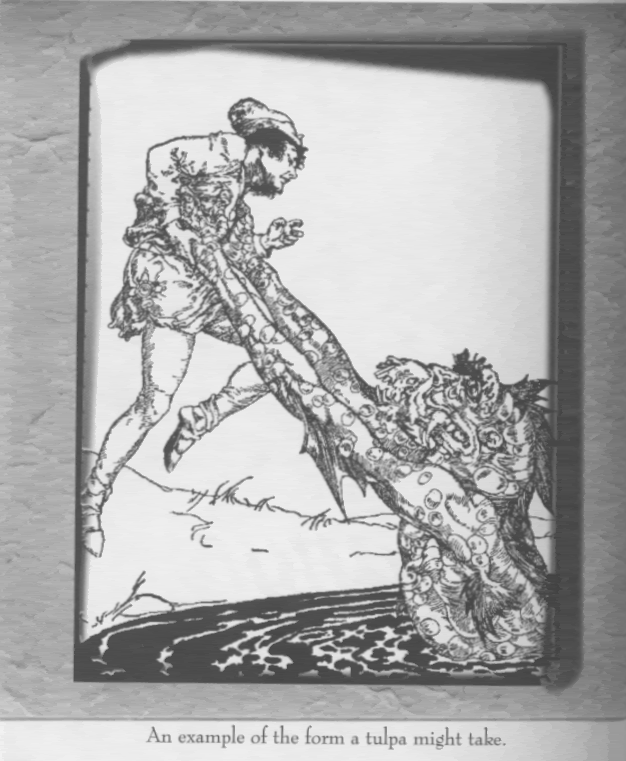
Paranormalizing the Popular through the Tibetan Tulpa: Or what the next Dalai Lama, the X Files, and Affect Theory (might) have in common

fua.gif

This most recent essay of mine on Savage Minds also took place as part of a running conversation with popular media and representations. I think that it does a decent job of re-iterating and extending some of the ideas that came up in the Tibetan aliens and singing bowl essays about the sometimes bewildering cross-fertilizations between Indo-Tibetan esotericisms, Western occultism, and popular culture.

There’s a lot more to be said in all this about Continue reading

Tripping on Good Vibrations: Cultural Commodification and ‘Tibetan’ Singing Bowls


pizza yoga.jpeg

This was also a piece I did not expect to write. Popular media, and reactions to popular media however, got me thinking more about issues of commodification and cultural appropriation, and the singing bowl turned out to be a particularly useful entry point into a lot of these.

I find it quite surprising that so little academic material has been written about singing bowls and their history, despite them being such iconic and familiar New Age objects. Continue reading