

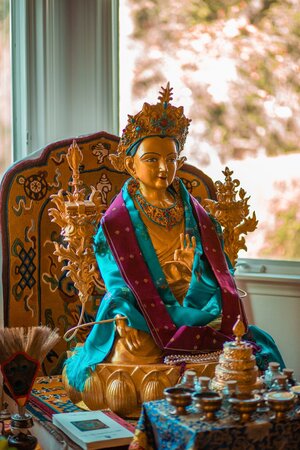
The Tibetan physician and tantric yogi Yuthok Yönten Gönpo is one of the most important figures in the history of Tibetan medicine or Sowa Rigpa, ‘The Science of Healing’ (Yuthok is pronounced a bit like the English words ‘you’ tock’. The th represents aspiration rather than a dipthong, so you should use a breathy tah sound as in the English word ‘top’, rather than a th sound like in ‘thought’ or ‘these’!). Born in or around 1126 in Western Tibet, Yuthok is one of Sowa Rigpa’s chief systematizers. He is widely regarded as the author of the Gyü Zhi or ‘Four Medical Tantras’, the four-volume Tibetan-language medical textbook which still holds pride of place in Tibetan medical curricula today. Yuthok’s influence on the history of Tibetan medicine is pervasive, so pervasive that there are two of him. Two key figures in Sowa Rigpa history share the name Yuthok Yönten Gönpo. The eleventh century Yuthok pictured above is referred to as Yuthok Sarma or ‘Yuthok the Younger’. Yuthok Nyingma or ‘Yuthok the Elder’, on the other hand, refers to a different hereditary doctor from the eighth century, who is said to be the biological ancestor of Yuthok the Younger. Yuthok the Younger is also understood to be Yuthok the Elder’s reincarnation. There is a close connection between these two figures and their life-stories often blur considerably. Both Yuthok the Younger and Elder are celebrated for their accomplishments in medicine and meditation. Both are remembered as having been consummate ngak-men or ‘tantric yogi-doctors’: individuals equally trained in medical science and tantric yoga and ritual. The biographies of both Yuthoks are hagiographies – in both his younger and older incarnation, Yuthok appears as both a highly-skilled physician and as a highly realized siddha, a tantric saint or adept capable of reading minds and performing miracles. Both Yuthoks are said to have achieved the ‘Rainbow Body’, to have dissolved into light upon their death.





 A Perfumed Skull