Anthropology, Esotericism, and ‘Fringe’ Buddhism: Interview on the Imperfect Buddha Podcast

devil-woodcut

A month or two ago I did an interview with Matthew O’Connell for his ‘Imperfect Buddha’ podcast, where I talked about doing research on Western esotericism as an anthropologist and scholar-practitioner, and about some of the more ‘fringe’ dimensions of global Tibetan Buddhism today. I ended up talking a lot about myself and not that much about the specific details of my research, and Matthew barely got a word in edgeways, but it is what it is. Many of the posts and articles on this blog get a mention. I no doubt said a lot of things that would benefit from further qualification and which I would probably take issue with if I heard myself saying them now. The thought of listening to my voice drone on for that long curdles my juices and fills me with acute horror though, so I’m can’t be sure – you’ll just have to listen to the interview yourselves and tell me how it makes you feel instead.

Shout out to Matt for arranging things, and thinking I was interesting enough to have on the show. Let me know what you think!

https://posttraditionalbuddhism.com/2016/07/27/8-0-imperfect-buddha-podcast-ben-joffe-on-the-paranormal-tibetan-buddhism-the-ngakpa/


‘As Wealthy as a King’: Common Tools and Substances used in Mantra Healing

10403621_860892917278683_1693782508765882216_n

(A regal-looking Dilgo Khyentse Rinpoche (1910-1991), with tantric ritual bell or dril bu, seated behind a sbyin sreg or ‘burnt offering’ fire)

As a follow-up to my recent translation of Dr Nida Chenagtang’s chapter on how mantras work, I decided to translate a subsequent chapter in Dr Nida’s Mantra Healing book which deals with the ritual tools and substances most commonly used by ngakpa/ma. Dr Nida la gives a brief summary of some of the most salient ritual implements and objects used by mantra-healers and tantric wizards, and describes their functions, rationale, and construction, along with rules for their proper handling and use. The subject of ritual tools necessarily ties in which more general, theoretical reflections I have made on this blog about the role of materiality in magic and religion. How ought we to understand the status of magical, blessed or powerful objects or materials, in a Buddhist context where nothing that exists has any innate or enduring substantiality on the ultimate level, or for that matter where subtle, ‘imagined forms’ may be just as ontologically real, agentive, and efficacious as gross, material ones? As we saw in Dr Nida’s earlier chapter about mantras’ efficacy, the ultimate emptiness of phenomena is in fact directly related to their functionality or agency – it is precisely because material things are impermanent, compounded and conditional, that they are able to be transformed, and to transform in kind. Buddhist notions of dependent-origination and emptiness are wholesale dispensations that apply across divides of body-and-mind, real-and-representational, which are themselves also categories that operate quite differently in Buddhist philosophical contexts versus non-Buddhist ones. Continue reading

The Magic of Interdependence: A general description of the view of how mantras produce results

13453311_10154998433637907_2020741261_o (2).jpg

(Guru Rinpoche, the Precious Guru Padmasambhava surrounded by his own mantra, and the mantra of Dependent Origination)

In an earlier post, I mentioned Dr Nida Chenagtsang’s new book on the subject of mantra healing, which was written with Yeshe Drolma and published in December of last year by the Beijing People’s Press. The book, whose full title is “The Science of Interdependent Connection Mantra Healing’ (rten ‘brel sngags bcos thabs kyi rig pa), is a significant achievement. While there is no small number of mantra collections (sngags ‘bum) and tantric grimoires (sngags kyi be’u bum) within Tibetan literary tradition, these are, by and large, books of mantras and magical rituals, and not books about them. Dr Nida’s 339 page volume is thus ground-breaking. It represents one of the first Tibetan language treatments of its kind, in which a native practitioner and scholar of Tibetan traditional medicine and tantric ritual provides a general overview of mantra healing in theory and practice, and supplies a fuller range of interpretive frameworks and historical context for Tibetan approaches to mantra use. Continue reading

Signs of Sinicization: Katia Buffetrille on Road Signs and Cultural Erasure in Tibet

buffetrille.jpg

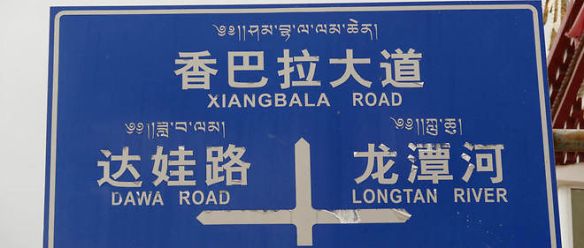
The following is a quick translation into English from French that I made of what seems like an excerpt of a longer interview that Le Point.fr did with anthropologist and Tibetologist Katia Buffetrille. Although it is short, it covers important ground, so I thought non-readers of French might appreciate a version in English. The focus of the interview is the topic of Han Chinese Sincization of Tibet and Tibetans. In a very nice and concise way Katia, describes the little everyday ways – particularly in relation to naming – that Tibetan cultural and lived, embodied realities are erased and suppressed to make way for the steam-rolling priorities of Chinese settler-occupiers. Continue reading

An Unhappy Mother’s Day: Tibetan Self-immolation protests and Splaining over Corpses

sonam tso.jpg

(Tibetan self-immolater Sonam Tso)

Today is Mother’s Day. The day before yesterday, on Friday, the 6th of May, news broke about yet another Tibetan self-immolation protest that took place inside Tibet. This was delayed news, however. The self-immolation took place some two months ago, but Tibetan exile media organizations had only now been able to even verify that it had happened. The woman who self-immolated was a mother of five. I had got up from being asleep and saw the news on Facebook. I shared this link, after quickly making a rough translation of the initial written information in the article: Continue reading

‘His Weight in Gold’: Women of Power in Game of Thrones and Tibetan Buddhism (*SPOILERS!)

melisandre

FOR THE INTERNET IS DARK AND FULL OF SPOILERS! GAME OF THRONES AND TIBETAN BUDDDHIST SPOILERS AHEAD FOR THOSE WHO HAVE NOT WATCHED THE MOST RECENT EPISODE OF THE SERIES OR HAVE NOT ACHIEVED ENLIGHTENMENT!

Last week’s episode of Game of Thrones, the second in this current season, saw fans’ questions about whether we’d be seeing more of a moving version of the Lord Commander of the Night’s Watch Jon Snow put to rest. Continue reading

Secrets of the Scoby: Tibetan Taoist Gummiberry Juice and Boulder’s Buddha’s Brew

gummiberry juice

I was recently reminded of an old entry from the annals of Shangri-La La Land: the apparently Tibetan fermented drink known as ‘Jun’. Jun is a relative of the classic fermented health-drink Kombucha. Whereas Kombucha is born from the alchemy of adding a kombucha culture or ‘scoby’ to black tea and sugar, Jun is made from Jun cultures mixed with green tea and honey. According to popular legend, besides being more obscure and more magical than Kombucha, Jun also hails from Tibet.

On August 4th, 2010, Emma Blue penned an article for The Elephant Journal which she, mincing no words, called ‘Jun: Nobody Wants us to Know About it’. The Elephant Journal claims to be committed to a more thoughtful, ‘non-New Agey’ brand of spirituality, but you could be forgiven for not quite believing this after reading Blue’s article. Continue reading

De-calcifying your Pineal Gland, and other New Age Literalisms

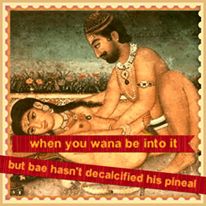
“It’s not you…I just don’t think our pineal glands are in the same place right now.”#NewAgeDatingProblems

A while back, I was kinda bored and for reasons I still don’t fully understand, I made this meme. I thought it came out quite well.

decalcifying your pineal gland.jpg

I was just going to post this meme here, but then it got me thinking. Jokes aside, I find the idea of doing something like ‘de-calcifying your pineal gland’ quite fascinating. The concept is one of a panoply of New Age lifestyle/purificatory options, which rely at least in part on a veneer of scienc-i-ness for their legitimacy. Continue reading

So, You Want to be a Tantric Wizard, Huh?

so you want to be a tantric wizard


Part of my current PhD research focuses on the overlaps – and divergences – between ideas about what practicing tantra means in ‘traditional’ or ‘indigenous’ Asian contexts and in what can be called ‘neo’ or ‘New Age’ tantric settings.

Recently, I’ve been coming across a great number of (white) people who describe themselves as ‘Tantrikas’ and ‘Dakinis’, traditional terms for somebody following the path of (an often but not always non-celibate) tantric practitioner and vow-holder. The (often, but not always) white people who use these terms most liberally frequently seem to be operating well outside of the boundaries of traditional Indian or Tibetan tantra, that is, the native religious system of someone like His Holiness the Dalai Lama. As an anthropologist, I’m not interested in categorically dismissing or merely debunking these white self-avowed tantric masters and goddesses Continue reading

A Modern Tibetan Refuge Formula

internet refuge

I was sent this parody of the Tibetan Buddhist ‘refuge formula’, as seen on Tibetan social media, by a young Tibetan monk friend in McLeod Ganj. There’s potential commentary here on how much Tibetans depend today on social media and virtual connectivity to keep their sense of community together in diaspora. Continue reading