Shut up and Recite! Naropa’s Pith Instruction on Mantra Practice

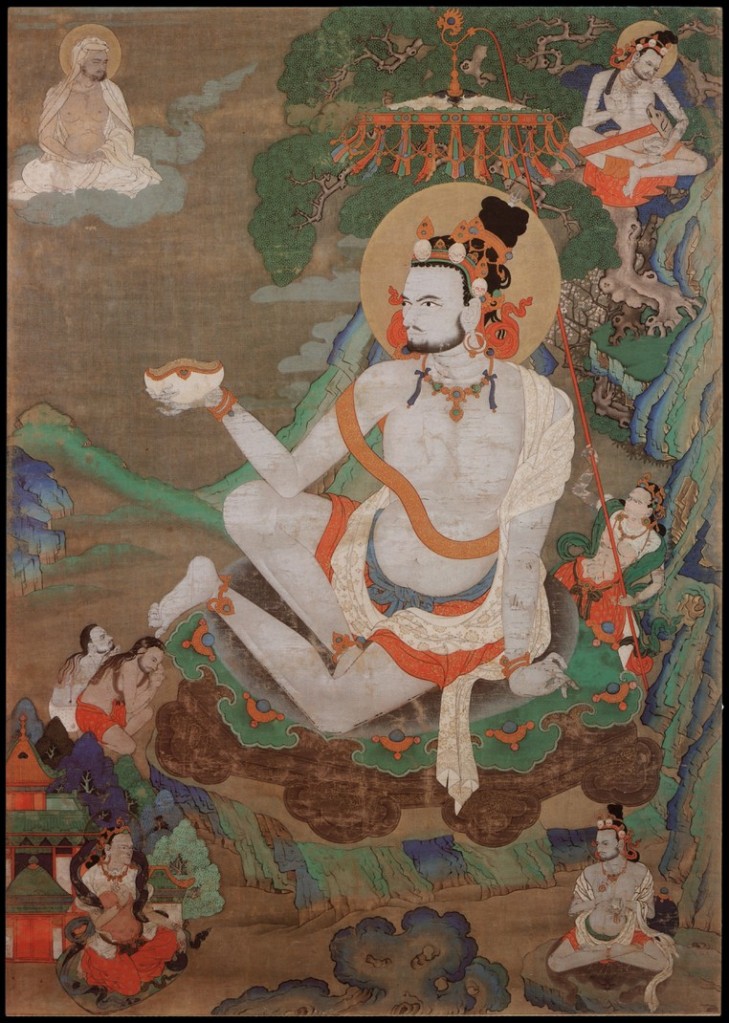
The Great Siddha Naropa, who is famously associated with Six ‘Dharmas’ or Completion Stage yogic disciplines.

Yesterday, the Naldjor Facebook page, a wonderful resource for texts and images related to Tibetan Tantric Buddhism and Yoga, shared a short text composed by Naropa, the famous Bengali Mahasiddha or ‘greatly accomplished’ Tantric saint who lived and taught in the 11th century (Naropa was famously put through great trails by his Guru Tilopa after he left his life as a monastic professor behind. For a brief summary of his life, see the Princeton Dictionary of Buddhism’s entry for him shared on Tsadra’s Buddha Nature Project page, which is incidentally where I also got the above image from. The text in question has to do with mantra recitation and it is a mengngak མན་ངག་ or upadesha in Sanskrit – that is, a text of ‘pith, oral instructions’. Mengngak are usually related to meditation, medicine, or ritual practice and in this text Naropa gives a list of twenty-one do’s and don’ts regarding mantra practice for practitioners who want to cultivate ngak ki nüpa, སྔགས་ཀྱི་ནུས་པ་, i.e. ‘mantric efficacy’ or ‘power’. The Naldjor page administrator requested that English translations of the text be shared, so I thought I would offer one here. Naropa’s text was also one of the many sources Dr Nida Chenagtsang drew on when writing his Tibetan-language book on mantra healing and some of Naropa’s instructions appear in Dr Nida’s own ‘do’s and dont’s’ chapter from the book (see here for my rough translation). Dr Nida also often refers to points from Naropa’s text in his classes, so I thought it would be useful to share a full translation, along with some brief commentary. I will give the full text and translation below, followed by a few explanations about terminology and translation choices. I have put asterisks alongside the points which have variant renderings or interpretations.

Continue reading

Some Dos and Don’ts of Mantric or Tantric Healing

nyingma yogi chapman


(A photograph of an itinerant Nyingmapa yogi with prominently displayed trengwa or Buddhist prayer beads, one of the central tools of mantra healing, taken in 1936 in Lhasa by British army officer Frederick Spencer Chapman, 1907-1971. Chapman visited the Tibetan capitol between 1936 and 1937, where he served as personal secretary to Basil Gould, the British Raj Political Officer to Sikkim, Bhutan and Tibet. Gould went to Tibet in the hopes of persuading the then 9th Panchen Lama to return to Tibet from China, to where he had fled after the 13th Dalai Lama had clamped down on his power and holding due to political differences) 

In the post that follows I offer yet another translation of a chapter from Tibetan tantric yogi and traditional doctor Dr Nida Chenagtsang’s book on Tibetan Mantra Healing (I’ve already provided translations of a number of chapters from this book, called rten ‘brel sngags bcos rig pa in Tibetan, here on my blog – you can find these posts by searching under the tags ‘dr nyida chenaktsang’ and ‘mantra healing’). In this short chapter Dr Nida provides an overview of ‘things to avoid and things to take up’ (spang blang) when doing mantra healing, using a traditional Buddhist turn of phrase which I’ve rendered more colloquially and chattily here as ‘dos and don’ts’. In the sections that follow, Dr Nida outlines suggested everyday behaviour and dietary prohibitions for tantrikas and mantrins and describes common ritual taboos connected with mantra healing practice as well as the optimal times and locations to do different kinds of tantric or mantric rituals.

Central to Dr Nida’s explanations is the concept of ngaki nüpa (sngags kyi nus pa) or ‘mantric/tantric power’ or ‘efficacy’. Anyone can recite the syllables of a mantra, but according to Tibetan cultural understanding there are a number of factors which contribute to whether or not a mantra will actually produce tangible results Continue reading

To See is to Call: Tantric Visualization, Summoning Spirits and the Mind as Petting Zoo

dakini-09

(Crushed marble sculptural installation ‘Flying Dakini’ 2014, by artist Agnes Arellano)

The other day I got sucked into a Facebook comment thread which got me thinking about the connection between translation strategies and the ways that practitioners think about and actually practice religious texts. To give you a little context, the thread was about spirit conjuration procedures and offering practices as found in Western magical traditions, and as the discussion unfolded I found myself reflecting upon the way that certain key technical terms often found in Tibetan sadhanas or tantric ritual manuals have been translated into English.

Translation is a double-edged process – to translate a thing involves both drawing it near and holding it apart. Depending on the circumstances, understanding can arise as much from domesticating a term in a target language as it can from choosing to hold onto a word’s strangeness through a literal translation. What is lost and gained, for example, when we translate the Sanskrit Dakini/Tibetan Khandroma – a tantric goddess – with a loaded Judeo-Christian-Islamic term like angel, and what is obscured, what is illuminated when we opt for say, a literal translation of the Tibetan term (khandroma, mkha’ ‘gro ma) ‘female sky-goer’? Continue reading

Embodying Healing: Tantric Ritual Short-hand and the Training of Anthropological Attention

AH syllable.jpg

Elaborate ritual procedures are a hallmark of Indo-Tibetan tantra. Tantric rites are often long and complex. Ceremonies typically involve multiple parts or stages, replete with lengthy chanted liturgies, extensive visualizations and gestures, and the making of both physical and imagined offerings. The ability to memorize such procedures, and to properly and elegantly execute the intricate choreographies of body posture and movement, recited mantras, and imagined forms which they require, is crucial to tantric expertise. Large-scale and extended rituals which involve a lot of people, ritual trappings, and processes are important in Tibetan Buddhist contexts and are conducted frequently. Yet the prevalence of externally elaborate ritual performances should not be taken to mean that smaller, quicker and more ‘internal’ rites are not also a vital part of Tibetan ritual specialists’ work. Continue reading