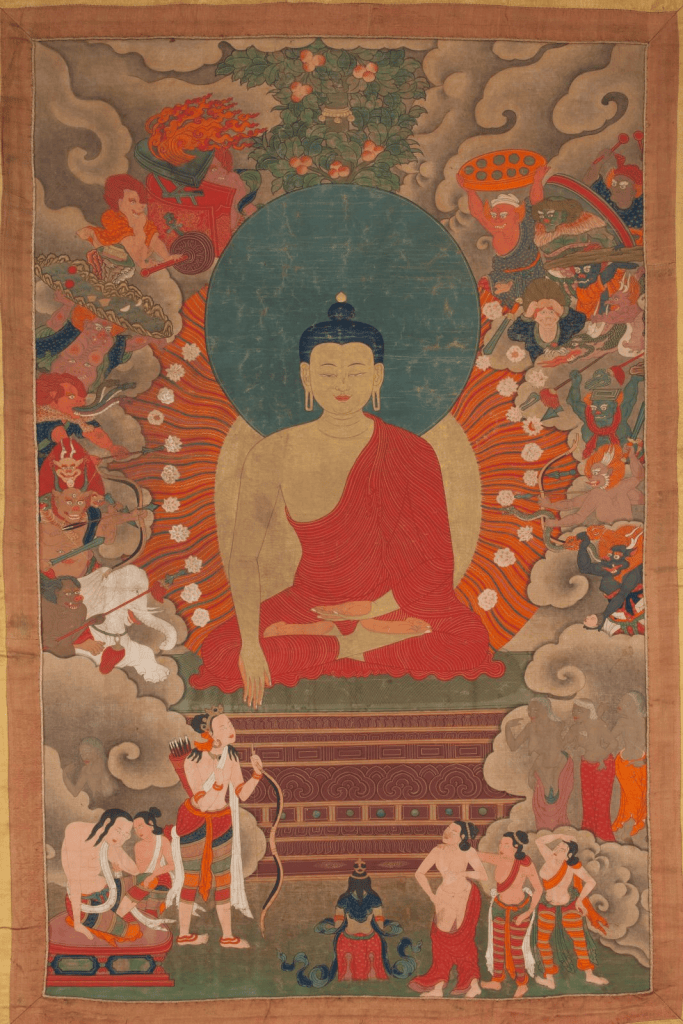
Four Common Devils: Patrül Rinpoche’s Text on Diagnosing and Avoiding Maras, Part I

A nineteenth century tangka painting of the Buddha conquering maras, housed at Rubin Museum of Himalayan Art, purchased from the Collection of Navin Kumar, New York. See here for more details.

In the interest of starting to post here a bit more regularly, I figured I would share, in installments, a rough translation of an interesting Tibetan text I came across recently. The text is by Dza Patrül Rinpoche (1808 – 1887 – Patrül has become the quasi-standard English phoneticization, but it could just as well be Peltrül), a prominent scholar-practitioner of the Nyingma school of Tibetan Buddhism, who is perhaps best known today for his extensive commentary on the ngöndro, i.e. the foundational, preliminary practices of the Longchen Nyingthig system, called ཀུན་བཟང་བླ་མའི་ཞལ་ལུང་ Künzang Lamé Zhelung, ‘The Direct Oral Instructions of the Guru who is one and the same as Samantabhadra’, better-known as ‘Words of My Perfect Teacher’. The text I’d like to share here is, also included in Patrül Rinpoche’s collected works and is titled བདུད་ཀྱི་རྒྱུ་བརྟགས་ཏེ་སྤོང་ཚུལ་གྱི་མན་ངག་བདུད་ལས་རྣམ་རྒྱལ་ ‘Complete Victory over Mara: Pith Instructions on how to Diagnose the Causes of Mara or Obstructing Demons and the Methods for Avoiding Them’. I cited the final paragraph from this ‘Complete Victory over Mara’ text in a recent interview I did with Steve James on the Guru Viking podcast on the Tibetan concept of gek or obstacles which arise in the course of meditation and spiritual practice. As it happens, the text is not an original composition, but as Patrül explains in the colophon, is his reworking of a chapter by the same name found in ‘The Heap of Precious Pith Oral Instructions’ མན་ངག་རིན་ཆེན་སྤུངས་པ་ Mengngak Rinchen Pungpa, a treatise by the influential Tibetan Kadampa master Chegompa, who was born in 1130. Patrül Rinpoche notes that he has summarized the original chapter, has edited its wording slightly, in order to rework it into ‘notes’ or a more bulleted form (ཟིན་ཐུན་དུ་སྤེལ་བ་). This is very kind of him, since it makes the key points of Chegompa’s chapter easier for students like us to access, study, and memorize. Since there’s so much of interest in the text, I’d like to share it in its entirety here, with a few personal reflections along the way.

Continue reading →

How to Mind Your Tantric Business: Padmasambhava’s Parting Words of Advice to Tibetan Ngakpa

188 Padmasambhava

(The One Born From A Lotus, the Precious tantric Buddhist Guru, Padmasambhava)

One of my favourite genres of Tibetan Buddhist literature is so-called ‘words or songs of advice’ texts, known as gtam or zhal gdams in Tibetan. These sorts of texts are great for a number of reasons. For one, they tend to be both pithy and poetic, which makes them a pleasure to read. They often have quite a colloquial flavour, which makes them interesting in terms of style and register. And they are also uniquely practical. While their ethical orientation means that they are focused on ideals and best case-scenarios, the fact that they are intended to be useful as guides means that they are forced to point out faults realistically, to take stock of where their target audience may actually be in their lives or religious practice. After all, the only thing worse than unsolicited advice is advice that has no bearing on the realities of one’s life.

I previously translated and shared a ‘words of advice’ text aimed at ngakpa or non-celibate, tantric vow-holder yogi-householders on this blog. You can read that text by famous 20th century ngakpa Dilgo Khyentse Rinpoche, and some stray thoughts on it here. Today I was taking a read of the much older text of advice for ngakpa on which Dilgo Khyentse Rinpoche based his later commentary: the ‘final words’ or parting testament (zhal chems) of the legendary ON (‘Original Ngakpa’) Padmasambhava (‘The Lotus Born one’) a.k.a. Guru Rinpoche, the ‘Precious Guru’, as found in a biography of this Great Tantric Master who secured the spread of Buddhism in Tibet which was revealed by the tantric visionary saint Nyangral Nyima Ozer in the 12th century. Dilgo Khyentse’s words of advice for ngakpa in the early twentieth century are directly inspired by the testament of the eighth century Padmasambhava as reported in Nyangral Nyima Ozer’s twelfth century revelation, Continue reading →