Shut up and Recite! Naropa’s Pith Instruction on Mantra Practice

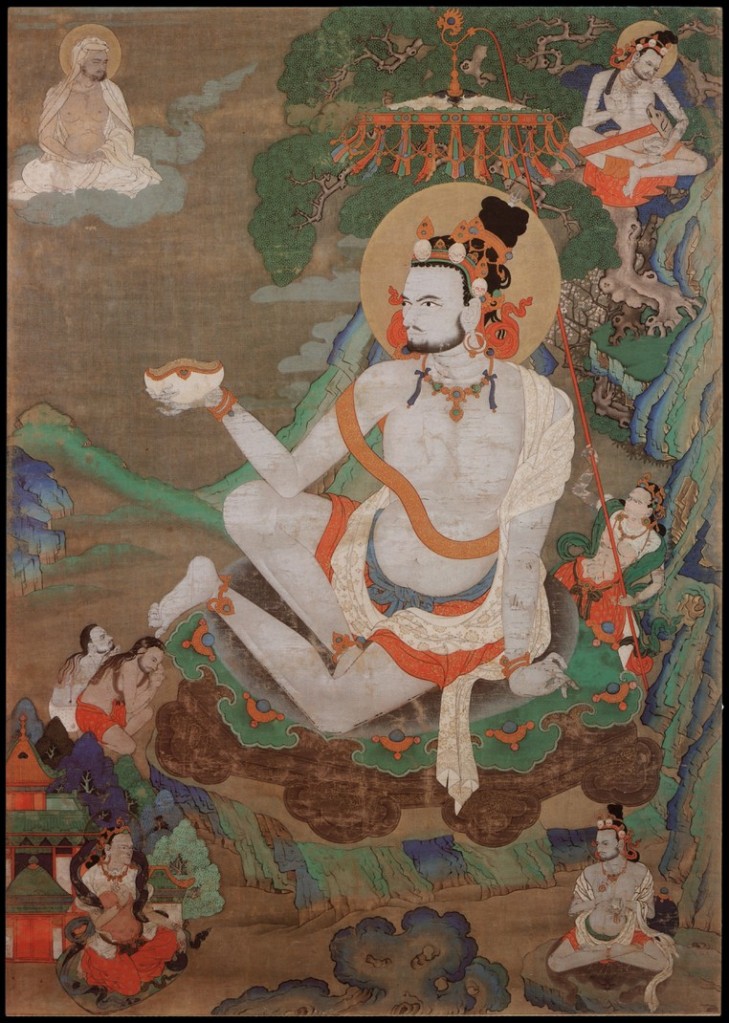
The Great Siddha Naropa, who is famously associated with Six ‘Dharmas’ or Completion Stage yogic disciplines.

Yesterday, the Naldjor Facebook page, a wonderful resource for texts and images related to Tibetan Tantric Buddhism and Yoga, shared a short text composed by Naropa, the famous Bengali Mahasiddha or ‘greatly accomplished’ Tantric saint who lived and taught in the 11th century (Naropa was famously put through great trails by his Guru Tilopa after he left his life as a monastic professor behind. For a brief summary of his life, see the Princeton Dictionary of Buddhism’s entry for him shared on Tsadra’s Buddha Nature Project page, which is incidentally where I also got the above image from. The text in question has to do with mantra recitation and it is a mengngak མན་ངག་ or upadesha in Sanskrit – that is, a text of ‘pith, oral instructions’. Mengngak are usually related to meditation, medicine, or ritual practice and in this text Naropa gives a list of twenty-one do’s and don’ts regarding mantra practice for practitioners who want to cultivate ngak ki nüpa, སྔགས་ཀྱི་ནུས་པ་, i.e. ‘mantric efficacy’ or ‘power’. The Naldjor page administrator requested that English translations of the text be shared, so I thought I would offer one here. Naropa’s text was also one of the many sources Dr Nida Chenagtsang drew on when writing his Tibetan-language book on mantra healing and some of Naropa’s instructions appear in Dr Nida’s own ‘do’s and dont’s’ chapter from the book (see here for my rough translation). Dr Nida also often refers to points from Naropa’s text in his classes, so I thought it would be useful to share a full translation, along with some brief commentary. I will give the full text and translation below, followed by a few explanations about terminology and translation choices. I have put asterisks alongside the points which have variant renderings or interpretations.

Continue reading

Illuminating the Truth: Mipam Rinpoche’s Butter Lamp Divination Instructions

A single burning marmé མར་མེ or Tibetan butter lamp. Photo courtesy of Chris Fynn – Own work, CC BY-SA 3.0, https://commons.wikimedia.org/w/index.php?curid=9427366.

I haven’t posted any translations or blah blahs on here for quite some time. The twenty-somethings in my life seem to view maintaining a blog with the same blend of emotions that I’d view someone who still owned and regularly fed a Tamagotchi. But since I’m not ready for shortform video formats and don’t see myself going for a Podcast-Patreon combo right now, here I am again, punching at my keyboard and making words on WordPress. Maybe some of you will read them. Maybe blogs will soon be cool again along with Tamagotchis and everything else from the late 90s and early 2000s. Who can say? At any rate, I have a bunch of half-finished posts to share, so I thought I’d try to build momentum again by ignoring all of those and sharing a translation I made of a Tibetan text on butter lamp divination I came across instead.

I’ve written about divination here before (see my post on Tibetan prayer-bead divination, knuckle bone divination, and this post on Somali geomancy, for example) and it’s honestly one of my favourite topics to talk and think about (I would say that divination is also one of my favourite things to do as well but that’s more complicated. I love the art of divination and I’ve been doing it for a long time, since before I hit puberty or started cooking my own meals. Divinatory procedures never cease to thrill and amaze me. Studying and practicing divination is a big passion. Even so, the divinatory process and encounter is still something I approach with trepidation, are things that remain strange and fraught to me. I try not to enter into divination lightly – as happy as I am when readings can help clients gain confidence, clarity, and navigate life better, I still approach them with a certain amount of trepidation. I am awed by how accurate and insightful divinatory processes can be but I am also troubled by the potential misuse of divination and am aware of the great responsibility involved in making use of it as a form of prediction and pastoral care. So, ‘enjoy’ is a bit misrepresentative. Maybe appreciate is better).

Anyway, with that preamble, let’s get into the butter lamp divination text which I’ve translated below. This text, which has no formal title, is one of several texts on interpreting signs and omens which appears in the sungbum གསུང་འབུམ or collected works of Ju Mipam Rinpoche, a.k.a. Jamyang Namgyel Gyatso (1846 – 1912).

Continue reading

White Robes, Matted Hair: My PhD Thesis on Tibetan Tantric Householders Now Available for Download

A detail from the medical thangka paintings commissioned by the Fifth Dalai Lama’s Regent, tantric yogi-doctor Desi Sangye Gyatso (1653 – 1705), as accompanying illustrations for the teachings in the Gyushi (rgyud bzhi) or ‘Four Medical Tantras’, the core textbook of exoteric Tibetan medicine. The detail depicts representative examples of the “two communities of Buddhist renouncers and virtuous spiritual guides who are [valid] objects for offerings/reverence”, that is, the community of ‘shaved-headed, saffron robed monastic renouncers’ and the ‘community of long-haired, white robe-wearing tantric yogi/nis or householder renouncers’ known as ngakpa/ma.

Great news, friends!

My full PhD dissertation in cultural anthropology, titled ‘White Robes, Matted Hair: Tibetan Tantric Householders, Moral Sexuality, and the Ambiguities of Esoteric Buddhist Expertise in Exile’ is now available open-access to download via ProQuest. It’s over 500 double-spaced pages and has more typos than I’d like, but it earned me a doctorate.

Here’s the thesis abstract and link for those who’d like to download and read it. I hope that whatever small insight and merit might be in its pages may spread and bring benefit!


“White Robes, Matted Hair: Tibetan Tantric Householders, Moral Sexuality, and the Ambiguities of Esoteric Buddhist Expertise in Exile

by Joffe, Ben Philip, Ph.D., University of Colorado at Boulder, 2019, 542; 27663085

Abstract (Summary)

This dissertation offers an ethnographic study of ngakpa/ma (sngags pa/ma, m.f.)–Tibetan Buddhist non-monastic, non-celibate tantric yogis and yoginis–living in the Tibetan diaspora. Like monks and nuns, ngakpa/ma are professionally religious, yet unlike their monastic counterparts they can marry, have families, and pursue worldly work. Living in ‘the village’ like ordinary laypeople but also spending much of their time in retreat or working as ritual specialists for hire, ngakpa/ma occupy a shifting, third space between monastic renunciation and worldly attachments. Based on roughly five years of fieldwork research conducted in Tibetan and Tibetan Buddhist communities in India, Nepal, Northeastern Tibet, and the United States, this thesis explores how ngakpa/mas’ historically decentralized, morally ambiguous esoteric expertise has become implicated in various projects of cultural preservation and reform for exile Tibetans, even as it has come to circulate and have meaning well beyond the purview of ethnic Tibetan communities and interests. Chapters One to Five offer an overview of how ngakpa/ma and ngakpa/ma orientations have been pinned down (or have failed to be pinned down) in exile, via language; gendered divisions of labor; in physical space and permanent institutions; through hair, clothing, and embodied comportment; and as part of new family and career trajectories. Chapters Six to Nine examine how contentious esoteric tantric yogic practices, associated with sexuality and Tibetan medicine in particular, are being popularized and reframed in exile in new ways and for new audiences as part of increasingly transnational networks of exchange. In these chapters, I underscore the polysemous quality of tantric practices, and reflect on my own collaborations with a Tibetan ngakpa-doctor to translate and share information on Tibetan tantric yogic practices more widely. In conclusion, I assess trends and quandaries that have dominated the academic study of secrecy and esoteric religions and highlight the implications and value of an ethnographic approach to researching tantric traditions.”

https://pqdtopen.proquest.com/doc/2335180529.html?FMT=ABS

Mirroring the Master: Making Magic in a Nineteenth Century Tibetan Book of Spells

Recently, a Facebook friend of mine shared an article from the popular anthropology blog Sapiens in the Folk Necromancy Facebook group that I co-moderate. This article, true to its title, sought to argue that AI (Artificial Intelligence) was similar to ‘magic’, at least in certain respects, and as understood by anthropologists at any rate. I approved my friend’s post to share with the group despite finding the article quite irritating. Being irritated about what people generally consider to be the minor or obscure details of things is arguably the bread-and-butter of academia, but I submit that I had a solid reason to be annoyed. Many of my disciplinary peers positively DELIGHT in writing ‘X thing is actually like Magic’ type hot-takes. I get why, of course. Our discipline has grappled more with the comparative study of what people often call ‘magic’, ‘science’, and ‘religion’ as ways of acting, knowing, and being in the world than probably any other. Considering how foundational witchcraft and magic are to the history and identity of our field, I guess every anthropologist is supposed to be able to at least trot out something about these topics. It’s our wheelhouse! The thing is – and here’s what bugs me – the anthropologists I typically see forwarding ‘X is really magic!’ arguments are almost never actually researchers of magical practices or of ritual specialists. They are almost always ethnographers who study ‘X’, whatever X may be. Continue reading

How to Mind Your Tantric Business: Padmasambhava’s Parting Words of Advice to Tibetan Ngakpa

188 Padmasambhava

(The One Born From A Lotus, the Precious tantric Buddhist Guru, Padmasambhava)

One of my favourite genres of Tibetan Buddhist literature is so-called ‘words or songs of advice’ texts, known as gtam or zhal gdams in Tibetan. These sorts of texts are great for a number of reasons. For one, they tend to be both pithy and poetic, which makes them a pleasure to read. They often have quite a colloquial flavour, which makes them interesting in terms of style and register. And they are also uniquely practical. While their ethical orientation means that they are focused on ideals and best case-scenarios, the fact that they are intended to be useful as guides means that they are forced to point out faults realistically, to take stock of where their target audience may actually be in their lives or religious practice. After all, the only thing worse than unsolicited advice is advice that has no bearing on the realities of one’s life.

I previously translated and shared a ‘words of advice’ text aimed at ngakpa or non-celibate, tantric vow-holder yogi-householders on this blog. You can read that text by famous 20th century ngakpa Dilgo Khyentse Rinpoche, and some stray thoughts on it here. Today I was taking a read of the much older text of advice for ngakpa on which Dilgo Khyentse Rinpoche based his later commentary: the ‘final words’ or parting testament (zhal chems) of the legendary ON (‘Original Ngakpa’) Padmasambhava (‘The Lotus Born one’) a.k.a. Guru Rinpoche, the ‘Precious Guru’, as found in a biography of this Great Tantric Master who secured the spread of Buddhism in Tibet which was revealed by the tantric visionary saint Nyangral Nyima Ozer in the 12th century. Dilgo Khyentse’s words of advice for ngakpa in the early twentieth century are directly inspired by the testament of the eighth century Padmasambhava as reported in Nyangral Nyima Ozer’s twelfth century revelation, Continue reading

‘The Yoga of Bliss’: A Foreword to Dr Nida Chenagtsang’s New Book on Tibetan Buddhist Sexual Yoga

Karmamudra_Cover_NoSpine.jpg

On this Easter Sunday, I am very happy to announce formally here on this blog the completion of a new book by Dr Nida Chenagtsang and Sky Press, Karmamudra: The Yoga of Bliss (Sexuality in Tibetan Medicine and Buddhism).

As some of you may know, I have been working as editor and translator for this project since 2016. In so many ways, it has been unlike anything I have worked on before. Dr Nida will be presenting the book at the 6th annual Tibetan Traditional Medicine Sorig Congress in Pisa, Italy in three weeks and it will be launched worldwide on April 25th. Here is the blurb for the book from Sky Press’ website:


“Karmamudra refers to the ancient Buddhist practice of partnered sexual yoga. Also known as ‘The Path of Skillful Means’ or ‘The Path of Great Bliss’, Karmamudra uses powerful meditation techniques to transform ordinary pleasure, worldly desire, and orgasm into vehicles for spiritual transformation and liberation. In this ground-breaking book, Dr Nida Chenagtsang draws on his extensive training in Tibetan medicine and yoga to clarify major misconceptions relating to Tibetan Buddhist Tantra in general and Tibetan Buddhist sexual yoga practices in particular. Demystifying sexual yoga without depreciating it, Dr Nida provides an overview of the relationship between Sutric and Tantric orientations in Tibetan Buddhism, offers explanations of Tantric vows, initiations, and subtle anatomy, and explores both bio-medical and traditional Tibetan ideas about sexual health and well-being.


Speaking in a colloquial style as a physician, teacher, yogi, and parent, he addresses issues of sexual abuse, well-being and empowerment in a learned, down-to-earth and compassionate way. Aiming to inform and empower, this book offers vital context and instructions through which beginner and advanced students of any gender or sexual orientation can learn to engage with typically destructive and distracting emotions in a skillful way. Drawing on special Karmamudra teachings found in the Yuthok Nyingthig tradition that are aimed at practitioners without any prior training in Tantric yoga, it offers safe and simple methods through which students can work with the raw energy of their desire and transform it into a source of blessings and benefit in their everyday lives.

Continue reading

Absent Fathers and Missing Camels: Notes on Sudanese Sand Divination

Mali geomancer

(A geomancer or sand diviner from Mali traces geomantic figures in a prepared bed of sand)

A few days ago a member of a Geomancy study group that I am a part of on Facebook posted some interesting links to 19th century material that mentions geomancy. Many of the links this person posted included accounts of geomantic procedures that European colonial explorers like Sir Richard Burton had observed during their travels through parts of Africa. One of the links was a little different however: it was a facsimile of Voyage au Darfour (Journey to Darfur), the 1845 translation into French of a travelogue written in Arabic by Sheikh Mohammed Ibn Omar El-Tounsy (Al-Tunisi), who served as chief reviewer of translations of medical texts translated from European languages into Arabic at the School of Medicine in Cairo. This particular source thus jumped out at me, not only for its content but because rather than yet another white colonist’s account of native culture, it represented the reflections of a colonized non-white foreigner observing cultural practices that were both different from and cognate with his own.

Continue reading

Telling the Future: Some Thoughts on Fortune, Fingers and Tibetan Rosary Divination

I have performed divinatory services for clients since I was about eleven years old. As both a scholar and a practitioner, I am deeply fascinated by the incredible range of – but also significant similarities between – forms of divination as practiced across the centuries and the globe, and I know that readers of this blog – many of whom also practice some kind of divination – are too. With that in mind, I thought I’d offer some casual thoughts and a few original rough translations relating to Tibetan divination practices here, with a focus on one type of prognostication in particular: ‘phreng mo (pronounced treng moh), or divination through the use of a prayer beads or rosaries (‘phreng ba). Continue reading

Tibetan Spells for Calling Vultures to a Corpse: On Human-Bird Relations and Practicing Magic

Himalayan griffon vulture running

(A Himalayan vulture coming in for landing)

A day or two ago I was looking through a compilation of simple Tibetan healing rituals when I came across a short entry on a genre of Tibetan magic that I find quite lovely and interesting: vulture summoning spells.  I thought I would share these spells here and offer some reflections on why I found them significant. Continue reading

Meditation Made Easy: Announcing Dr Nida Chenagtsang’s New Book ‘The Weapon of Light’

weapon of light cover

A week or few ago, Sky Press’s newest publication, The Weapon of Light: Introduction to Ati Yoga Meditation by Tibetan traditional doctor and tantric yogi Dr Nida Chenagtsang was released for sale. Since I helped with editing and translation for this book, you would think I would have thought to mention it on this blog, but distracted by other things as I was, I forgot to make an announcement. So, since ‘The Weapon of Light’ is actually quite a special little book, I thought I’d make a post about it now. Continue reading