‘The Man with the Turquoise Roof’: Spirits as Patients and how the Father of Tibetan Medicine got his Name

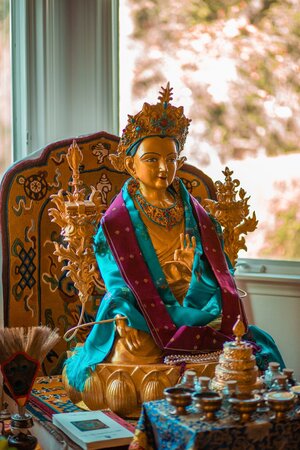
The statue of Yuthok the Younger at Yuthok Ling temple at Pure Land Farms, Topanga.

The Tibetan physician and tantric yogi Yuthok Yönten Gönpo is one of the most important figures in the history of Tibetan medicine or Sowa Rigpa, ‘The Science of Healing’ (Yuthok is pronounced a bit like the English words ‘you’ tock’. The th represents aspiration rather than a dipthong, so you should use a breathy tah sound as in the English word ‘top’, rather than a th sound like in ‘thought’ or ‘these’!). Born in or around 1126 in Western Tibet, Yuthok is one of Sowa Rigpa’s chief systematizers. He is widely regarded as the author of the Gyü Zhi or ‘Four Medical Tantras’, the four-volume Tibetan-language medical textbook which still holds pride of place in Tibetan medical curricula today. Yuthok’s influence on the history of Tibetan medicine is pervasive, so pervasive that there are two of him. Two key figures in Sowa Rigpa history share the name Yuthok Yönten Gönpo. The eleventh century Yuthok pictured above is referred to as Yuthok Sarma or ‘Yuthok the Younger’. Yuthok Nyingma or ‘Yuthok the Elder’, on the other hand, refers to a different hereditary doctor from the eighth century, who is said to be the biological ancestor of Yuthok the Younger. Yuthok the Younger is also understood to be Yuthok the Elder’s reincarnation. There is a close connection between these two figures and their life-stories often blur considerably. Both Yuthok the Younger and Elder are celebrated for their accomplishments in medicine and meditation. Both are remembered as having been consummate ngak-men or ‘tantric yogi-doctors’: individuals equally trained in medical science and tantric yoga and ritual. The biographies of both Yuthoks are hagiographies – in both his younger and older incarnation, Yuthok appears as both a highly-skilled physician and as a highly realized siddha, a tantric saint or adept capable of reading minds and performing miracles. Both Yuthoks are said to have achieved the ‘Rainbow Body’, to have dissolved into light upon their death.
Continue reading

On Interactions with Spirits in Tibetan Buddhism: New Interview on the Guru Viking Podcast

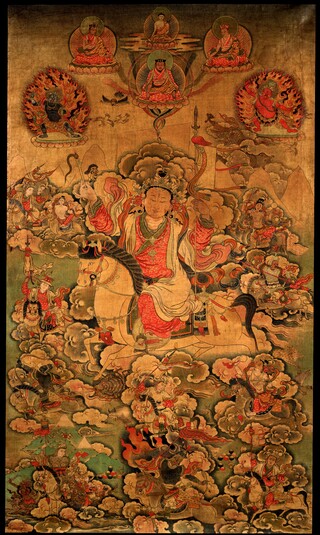
A 19th century Tibetan tangka or religious painting depicting Nyenchen Tanglha, an important Tibetan territorial protector deity associated with the sacred mountain range of the same name

A quick note to say I have a new interview up on the Guru Viking Podcast, hosted by Steve James. This one is supposed to be the first of three chats focusing on human-spirit interactions and relationships in different esoteric or magical traditions. Here’s some links, and a list of topics we touched on, as prepared by Steve for the time stamps. Let me know what you think!

Continue reading

Tibetan Spells for Calling Vultures to a Corpse: On Human-Bird Relations and Practicing Magic

Himalayan griffon vulture running

(A Himalayan vulture coming in for landing)

A day or two ago I was looking through a compilation of simple Tibetan healing rituals when I came across a short entry on a genre of Tibetan magic that I find quite lovely and interesting: vulture summoning spells.  I thought I would share these spells here and offer some reflections on why I found them significant. Continue reading

For the Religion and the Race: Words of Praise for Tibetan Non-Celibate Tantrikas

(A depiction of prominent 19th century poet, meditation master and promoter of the ‘white robed, dreadlocked community’ or ngakpa tradition, Shabkar Tsokdruk Rangdrol)

Recently, some non-Tibetan practitioners of Tibetan tantric Buddhism or Vajrayana were asking me about some informal advice texts or ‘speeches’ ༼གཏམ། tahm༽written in Tibetan by great ngakpa ༼སྔགས་པ།༽ or non-celibate tantric ritual specialists and whether these had been translated into English. In the course of looking into some of these older texts, I was reminded of a Tibetan blog post from 2009, which represents an interesting variation on the genre of advice speech for ngakpas, by ngakpas. So I thought I would translate it – very roughly! – and share it here.

Continue reading