New Book of Translated Commentaries on Yuthok’s Ati Yoga

Mirror_of_Light_SkyPress_Color_CoverOnly_6x9.indd

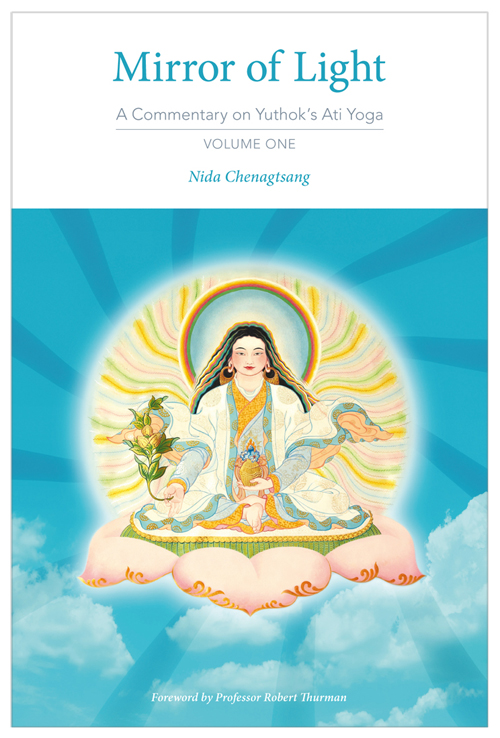
Some happy news. Recently, I produced some English translations of commentaries written in Tibetan by Dr Nida Chenagtsang on the special Ati Yoga (Dzogchen) instructions of the Yuthok Nyingthig, the cycle of comprehensive tantric Buddhist teachings associated with Tibetan medicine and connected with Yuthok, the father and chief systematizer of Tibetan medicine who is said to have achieved full liberation in one life and to have dissolved into rainbow light at his death. These translations have now been combined with supplementary material to create a new book, ‘Mirror of Light: A Commentary on Yuthok’s Ati Yoga’ which will be published by SKY Press on the 9th of November 2016.

Continue reading

Embodying Healing: Tantric Ritual Short-hand and the Training of Anthropological Attention

AH syllable.jpg

Elaborate ritual procedures are a hallmark of Indo-Tibetan tantra. Tantric rites are often long and complex. Ceremonies typically involve multiple parts or stages, replete with lengthy chanted liturgies, extensive visualizations and gestures, and the making of both physical and imagined offerings. The ability to memorize such procedures, and to properly and elegantly execute the intricate choreographies of body posture and movement, recited mantras, and imagined forms which they require, is crucial to tantric expertise. Large-scale and extended rituals which involve a lot of people, ritual trappings, and processes are important in Tibetan Buddhist contexts and are conducted frequently. Yet the prevalence of externally elaborate ritual performances should not be taken to mean that smaller, quicker and more ‘internal’ rites are not also a vital part of Tibetan ritual specialists’ work. Continue reading

‘As Wealthy as a King’: Common Tools and Substances used in Mantra Healing

10403621_860892917278683_1693782508765882216_n

(A regal-looking Dilgo Khyentse Rinpoche (1910-1991), with tantric ritual bell or dril bu, seated behind a sbyin sreg or ‘burnt offering’ fire)

As a follow-up to my recent translation of Dr Nida Chenagtang’s chapter on how mantras work, I decided to translate a subsequent chapter in Dr Nida’s Mantra Healing book which deals with the ritual tools and substances most commonly used by ngakpa/ma. Dr Nida la gives a brief summary of some of the most salient ritual implements and objects used by mantra-healers and tantric wizards, and describes their functions, rationale, and construction, along with rules for their proper handling and use. The subject of ritual tools necessarily ties in which more general, theoretical reflections I have made on this blog about the role of materiality in magic and religion. How ought we to understand the status of magical, blessed or powerful objects or materials, in a Buddhist context where nothing that exists has any innate or enduring substantiality on the ultimate level, or for that matter where subtle, ‘imagined forms’ may be just as ontologically real, agentive, and efficacious as gross, material ones? As we saw in Dr Nida’s earlier chapter about mantras’ efficacy, the ultimate emptiness of phenomena is in fact directly related to their functionality or agency – it is precisely because material things are impermanent, compounded and conditional, that they are able to be transformed, and to transform in kind. Buddhist notions of dependent-origination and emptiness are wholesale dispensations that apply across divides of body-and-mind, real-and-representational, which are themselves also categories that operate quite differently in Buddhist philosophical contexts versus non-Buddhist ones. Continue reading

The Magic of Interdependence: A general description of the view of how mantras produce results

13453311_10154998433637907_2020741261_o (2).jpg

(Guru Rinpoche, the Precious Guru Padmasambhava surrounded by his own mantra, and the mantra of Dependent Origination)

In an earlier post, I mentioned Dr Nida Chenagtsang’s new book on the subject of mantra healing, which was written with Yeshe Drolma and published in December of last year by the Beijing People’s Press. The book, whose full title is “The Science of Interdependent Connection Mantra Healing’ (rten ‘brel sngags bcos thabs kyi rig pa), is a significant achievement. While there is no small number of mantra collections (sngags ‘bum) and tantric grimoires (sngags kyi be’u bum) within Tibetan literary tradition, these are, by and large, books of mantras and magical rituals, and not books about them. Dr Nida’s 339 page volume is thus ground-breaking. It represents one of the first Tibetan language treatments of its kind, in which a native practitioner and scholar of Tibetan traditional medicine and tantric ritual provides a general overview of mantra healing in theory and practice, and supplies a fuller range of interpretive frameworks and historical context for Tibetan approaches to mantra use. Continue reading

Tantric Sex Partners, Actual and ‘Imagined’: Tibetan Karmamudra, and the Life and Times of Lelung Jedrung Zhepai Dorje

lelung shepe dorje

(The Great Fifth Lelung Jedrung Rinpoche, Zhepai Dorje)

Recently, Tibetan scholar, traditional physician and yogi Dr Nyida Chenaktsang told me about (and gave me permission to read) a short text by the 18th century Tibetan yogi and visionary saint or ‘treasure revealer’, Lelung Jedrung Zhepai Dorje (sle lung rje drung bzhad pa’i rdo rje, 1697-1740). This saint, whose name means something like ‘the Jedrung reincanation, the laughing/proclaiming tantric thunderbolt, or non-dual reality from the Lelung region’, is also known by the personal names Trinlay Wangpo and Lobsang Trinlay. He was born in Ölga/Ölkha, a region in Lhoka in South-Western Tibet, and was recognized as the Fifth Jedrung Rinpoche – that is to say, as the reincarnation of Drubchen Namkha Gyaltsen (1326-1401), the celebrated master who was one of Je Tsongkhapa (1357-1419), the founder of the Gelukpa lineage’s, principal gurus. Yet, despite being the re-embodiment of a celibate master – of one who played mentor to boot to a figure strongly associated with the monastic regulation and circumscription of tantra in Tibet, AND despite the fact that Lelung Zhepai Dorje had himself received monk’s ordination from the Sixth Dalai Lama at the age of seven, the text that Dr Nyida brought to my attention has nothing to do with either vows of celibacy or monasticism. Continue reading

Tibetan ‘Yogi-Doctors’ Today: Professor Gojo Wangdu’s Preface to Dr Nida’s new book on Mantra Healing

image1 (7)

The following is a translation of Professor Gojo Wangdu’s preface to Dr Nida Chenagtsang’s new Tibetan-language volume on the ‘Interdependent/Auspicious Science of Mantra Healing’. In his preface, the Professor supplies a brief overview of Dr Nida’s upbringing, education, and achievements. He describes the important contributions that Dr Nida has made to re-invigorating Tibetan traditional medicine, like his efforts to preserve and revive lapsed oral lineage practices such as the ‘stick-therapy’ methods that were taught by Padampa Sangye and others centuries ago. The Professor makes a strong case for why Tibetan doctors today should practice as the founding lineage masters of Tibetan traditional medicine did, as ‘yogi or ngakpa doctors’, that is, as practitioners who seamlessly integrate mantra healing rituals, yogic practice, and medicine. He also responds to questions readers might have about the issue of secrecy, and of the pre-requisites – the transmissions and training – required to put mantra healing into practice to benefit beings. While the Professor follows the traditional Tibetan style of modestly talking-down his own achievements, he is a highly respected and learned scholar, and his endorsement of Dr Nida’s book speaks to its value.

Continue reading

Heroic Tibetan Man-buns on Ngakpa Update

David Chapman who runs the Ngakpa Update site asked to share my earlier post about Justin Bieber, dreadlocks and Tibetan tantric practitioners on his blog. The post includes a translated excerpt from an extensive Tibetan language essay by Dr Nida Chenagtsang, which offers comprehensive and clear details about Tibetan tantric specialists’ traditional styles of dress.

David collects a lot of really useful news and links connected to ngakpa practices and lineages on the page Continue reading

Justin Bieber, Heroic Man-buns and the Relative Meaning (and Meaninglessness) of Dreadlocks

Dreadlocks post

Debates about hairstyles, fashion, identity and culture have been in the news in the last few days. After posting pictures of his new blond dreadlocks, pop star Justin Bieber was roundly criticized for cultural appropriation – for capitalizing on a cultural aesthetic that in the US is historically associated with black histories, identities, and struggles. Commentators noted that while people/celebrities of colour in the US have been routinely criminalized or villianized for sporting a hairstyle connected to their history and experiences as minorities, when Bieber as a white person casually took on this style as his own it came with none of the meaning, and context, and also none of the backlash. Continue reading

Reaching the Rainbow with your feet on the Ground: An Essay on the Importance and Special Characteristics of the Yuthok Nyingthik

yuthok nyingthik post

Like all other Buddhist traditions, Vajrayana or tantric Buddhism offers a way out of the terrifying and bewildering morass of human suffering and habitude that is shorthanded as Samsara (འཁོར་བ་ khorwa in Tibetan, or ‘wandering around and around’). What stands out about the tantric path of liberation from suffering, though, is that rather than insisting that we completely reject  or avoid the perceptions and experiences that can easily mire us in suffering, Vajrayana proposes that the quickest and most convenient way out is through.

In my anthropological research on ngakpa/ma, I have written about how Vajrayana provides a unique philosophical framework for thinking about (and experiencing) the relationship between different levels of reality, the ultimate and the relative, inner and outer, mundane and extraordinary, subtle and gross. A large part of what makes tantra interesting is the way in which it plays with, and attempts to resolve the contrasts between more or less subtle levels of perception and activity, between what anthropologist of Buddhism Melford Spiro long ago called ‘nirvanic, karmic, and apotropaic’ levels of Buddhist philosophy and practice (that is, the goal of ultimate liberation, improved karma for better rebirth, and a focus on the conditions of this life here and now, respectively). While the ultimate or ‘extraordinary’ ‘super-power’ in Vajrayana is Buddhahood, tantric experts can (and should) develop all kinds of other abilities along the way so as to help beings. Ngakpa/ma are distinct for how they cultivate the highest view and attainments while apparently remaining firmly grounded in the midst of ‘worldly’ life and its everyday contingencies. Ngakpa/mas double up as both master-meditator yogis cultivating spiritual attainments in retreat at a remove from worldly obligations, and as fully-engaged householders who apply their expertise and the power of their attainments to the needs and problems of their own and others’ daily lives.

Continue reading

Mantra Healing is an Indispensable Branch of Tibetan Traditional Medicine

mantra healing indispensable

(An image of a tantric practitioner providing a life-enhancing empowerment to a patient, from the medical paintings commissioned by Desi Sangye Gyatso, 1653-1705, to accompany his commentaries of the root-tantras of the Tibetan medical tradition)

One of the first things that someone visiting Tibetan communities tends to encounter -whether they’re a foreign visitor or a transmigrating Tibetan baby – is mantras. These set-apart forms of speech, made up of specific patterns of sacred and largely untranslatable phrases and syllables, are performed with special kinds of cadence and affect which distinguish them from other sorts of utterance.

As their Sanskrit etymology suggests, mantras are ‘instruments of the mind’; holding awareness firm they help to generate various effects and qualities in the one who recites them. While many mantras are the specific sound-embodiment of deities and Buddha-beings, others are more action-based and ‘worldly’, and exist as powerful spells that in the hands of trained experts who have properly ‘activated’ them are supposed to be able to produce all kinds of results.

Many people today are familiar with Indo-Tibetan mantras but are perhaps less familiar with where exactly mantras come from. Below I have attached my very rough and inadequate translation of the first part of a three-part Tibetan blog-post which appeared on a website about Tibetan culture in 2013 (cf here). This essay which was written by Dr Nida Chenagtsang some years ago in Lhasa (and which someone called Rinchen shared independently on the website above) essay discusses the history of the use of mantras for healing (སྔགས་བཅོས་ཐབས་ ngakchö tuhp) in Tibet. Dr Nida stresses that notwithstanding Sowa Rigpa or Tibetan medicine’s investment in strongly ’empirical’ and ‘secular’ therapeutic methods, mantra healing is nonetheless an indispensable element of Tibetan medical history and practice. His piece also acknowledges that healing mantras are not unique to Buddhism, and thus shows how magic and ritual healing are areas of Tibetan cultural life which are uniquely hybrid and non-sectarian and which perhaps span beyond Buddhist hegemonies. In general, mantra healing points to a rich and complex field of history and practice, one that comprises both elite and everyday ‘folk’ actors and knowledge systems, which intertwine in fascinating ways.

Anyway, here’s the translation: Continue reading