Justin Bieber, Heroic Man-buns and the Relative Meaning (and Meaninglessness) of Dreadlocks

Dreadlocks post

Debates about hairstyles, fashion, identity and culture have been in the news in the last few days. After posting pictures of his new blond dreadlocks, pop star Justin Bieber was roundly criticized for cultural appropriation – for capitalizing on a cultural aesthetic that in the US is historically associated with black histories, identities, and struggles. Commentators noted that while people/celebrities of colour in the US have been routinely criminalized or villianized for sporting a hairstyle connected to their history and experiences as minorities, when Bieber as a white person casually took on this style as his own it came with none of the meaning, and context, and also none of the backlash. Continue reading

Mantra Healing is an Indispensable Branch of Tibetan Traditional Medicine

mantra healing indispensable

(An image of a tantric practitioner providing a life-enhancing empowerment to a patient, from the medical paintings commissioned by Desi Sangye Gyatso, 1653-1705, to accompany his commentaries of the root-tantras of the Tibetan medical tradition)

One of the first things that someone visiting Tibetan communities tends to encounter -whether they’re a foreign visitor or a transmigrating Tibetan baby – is mantras. These set-apart forms of speech, made up of specific patterns of sacred and largely untranslatable phrases and syllables, are performed with special kinds of cadence and affect which distinguish them from other sorts of utterance.

As their Sanskrit etymology suggests, mantras are ‘instruments of the mind’; holding awareness firm they help to generate various effects and qualities in the one who recites them. While many mantras are the specific sound-embodiment of deities and Buddha-beings, others are more action-based and ‘worldly’, and exist as powerful spells that in the hands of trained experts who have properly ‘activated’ them are supposed to be able to produce all kinds of results.

Many people today are familiar with Indo-Tibetan mantras but are perhaps less familiar with where exactly mantras come from. Below I have attached my very rough and inadequate translation of the first part of a three-part Tibetan blog-post which appeared on a website about Tibetan culture in 2013 (cf here). This essay which was written by Dr Nida Chenagtsang some years ago in Lhasa (and which someone called Rinchen shared independently on the website above) essay discusses the history of the use of mantras for healing (སྔགས་བཅོས་ཐབས་ ngakchö tuhp) in Tibet. Dr Nida stresses that notwithstanding Sowa Rigpa or Tibetan medicine’s investment in strongly ’empirical’ and ‘secular’ therapeutic methods, mantra healing is nonetheless an indispensable element of Tibetan medical history and practice. His piece also acknowledges that healing mantras are not unique to Buddhism, and thus shows how magic and ritual healing are areas of Tibetan cultural life which are uniquely hybrid and non-sectarian and which perhaps span beyond Buddhist hegemonies. In general, mantra healing points to a rich and complex field of history and practice, one that comprises both elite and everyday ‘folk’ actors and knowledge systems, which intertwine in fascinating ways.

Anyway, here’s the translation: Continue reading

“Doctor, there’s a Demon in my Drink!” Tibetan Grimoires and the Tibetan Medical Tradition


guru rinpoche beer spell tibetan grimoires

Padmasambhava (pictured above), the mythic tantric saint who ensured the flourishing of Buddhism in Tibet in the 8th century was both a fully realized being and a consummate sorcerer. He is credited with having tamed the unruly indigenous demons of Tibet and having helped establish the first Buddhist monastery on Tibetan soil. As Tibet’s ‘Second Buddha’ his cultural importance to Tibetans is hard to over-emphasize. This Lotus-Born Precious guru is the quintessential model for the non-celibate tantric practitioner or ngakpa. As a realized Buddha he is the practitioner’s own basic, pure and perfect nature, as a historical and cosmological figure he represents the model practitioner of the path of tantric Buddhism, the Secret Mantra Vehicle. In his dress, comportment, practices, activities, teachings, motivation, and view he embodies everything that the best tantric practitioner should be.

It is thus no surprise that Padmasambhava’s legendary activities should feature strongly in Tibetan magic. Compared to their counterparts in Western esotericism, Tibetan medico-magical practices, and Tibetan grimoires (ngak ki beubum, སྔགས་ཀྱི་བེའུ་བུམ) have received relatively little scholarly attention. This paucity of scholarly interest is perhaps exacerbated by the fact that the more spiritual dimensions of Sowa Rigpa, or Traditional Tibetan Medicine (TTM) have been formally excised from state-sponsored Sowa Rigpa curricula in contemporary China. Continue reading

A Tibetan Gun License, on the Eve of Invasion

gun license tibet

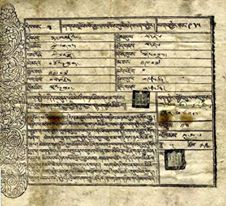
This is an amazing piece of history, courtesy of the illustrious historian of Tibet Gen Tsering Shakya la. What you see here is a Tibetan gun license, issued by the Tibetan central government in 1949. The document lists the gun-bearer’s names, place of birth and residence etc. and is license number NINE HUNDRED AND THIRTY FIVE Continue reading