Bee Careful what Ewe Wish Four: Monks behaving badly and Grammar-nazi Genies

dop dop post

Tibetan can be a confusing language – not least because it isn’t really one language at all. There’s still no standardized form of either written or spoken Tibetan, even if there have been attempts to produce them, and when it comes to the spoken language there are many, many registers and regional variations of both grammar, syntax, pronunciation and vocabulary. Tibetan language(s) is/are also notoriously filled with homophones and homonyms – like French, many Tibetan dialects have a lot of ‘silent’ or almost silent letters, and words that are spelled quite differently on paper may sound very similar to each other depending on one’s regional accent. The same word, either in its written or spoken incarnation, may have various meanings, depending on the context. The following story demonstrates just how dangerous language ambiguity can be. Continue reading

Reaching the Rainbow with your feet on the Ground: An Essay on the Importance and Special Characteristics of the Yuthok Nyingthik

yuthok nyingthik post

Like all other Buddhist traditions, Vajrayana or tantric Buddhism offers a way out of the terrifying and bewildering morass of human suffering and habitude that is shorthanded as Samsara (འཁོར་བ་ khorwa in Tibetan, or ‘wandering around and around’). What stands out about the tantric path of liberation from suffering, though, is that rather than insisting that we completely reject  or avoid the perceptions and experiences that can easily mire us in suffering, Vajrayana proposes that the quickest and most convenient way out is through.

In my anthropological research on ngakpa/ma, I have written about how Vajrayana provides a unique philosophical framework for thinking about (and experiencing) the relationship between different levels of reality, the ultimate and the relative, inner and outer, mundane and extraordinary, subtle and gross. A large part of what makes tantra interesting is the way in which it plays with, and attempts to resolve the contrasts between more or less subtle levels of perception and activity, between what anthropologist of Buddhism Melford Spiro long ago called ‘nirvanic, karmic, and apotropaic’ levels of Buddhist philosophy and practice (that is, the goal of ultimate liberation, improved karma for better rebirth, and a focus on the conditions of this life here and now, respectively). While the ultimate or ‘extraordinary’ ‘super-power’ in Vajrayana is Buddhahood, tantric experts can (and should) develop all kinds of other abilities along the way so as to help beings. Ngakpa/ma are distinct for how they cultivate the highest view and attainments while apparently remaining firmly grounded in the midst of ‘worldly’ life and its everyday contingencies. Ngakpa/mas double up as both master-meditator yogis cultivating spiritual attainments in retreat at a remove from worldly obligations, and as fully-engaged householders who apply their expertise and the power of their attainments to the needs and problems of their own and others’ daily lives.

Continue reading

Mantra Healing is an Indispensable Branch of Tibetan Traditional Medicine

mantra healing indispensable

(An image of a tantric practitioner providing a life-enhancing empowerment to a patient, from the medical paintings commissioned by Desi Sangye Gyatso, 1653-1705, to accompany his commentaries of the root-tantras of the Tibetan medical tradition)

One of the first things that someone visiting Tibetan communities tends to encounter -whether they’re a foreign visitor or a transmigrating Tibetan baby – is mantras. These set-apart forms of speech, made up of specific patterns of sacred and largely untranslatable phrases and syllables, are performed with special kinds of cadence and affect which distinguish them from other sorts of utterance.

As their Sanskrit etymology suggests, mantras are ‘instruments of the mind’; holding awareness firm they help to generate various effects and qualities in the one who recites them. While many mantras are the specific sound-embodiment of deities and Buddha-beings, others are more action-based and ‘worldly’, and exist as powerful spells that in the hands of trained experts who have properly ‘activated’ them are supposed to be able to produce all kinds of results.

Many people today are familiar with Indo-Tibetan mantras but are perhaps less familiar with where exactly mantras come from. Below I have attached my very rough and inadequate translation of the first part of a three-part Tibetan blog-post which appeared on a website about Tibetan culture in 2013 (cf here). This essay which was written by Dr Nida Chenagtsang some years ago in Lhasa (and which someone called Rinchen shared independently on the website above) essay discusses the history of the use of mantras for healing (སྔགས་བཅོས་ཐབས་ ngakchö tuhp) in Tibet. Dr Nida stresses that notwithstanding Sowa Rigpa or Tibetan medicine’s investment in strongly ’empirical’ and ‘secular’ therapeutic methods, mantra healing is nonetheless an indispensable element of Tibetan medical history and practice. His piece also acknowledges that healing mantras are not unique to Buddhism, and thus shows how magic and ritual healing are areas of Tibetan cultural life which are uniquely hybrid and non-sectarian and which perhaps span beyond Buddhist hegemonies. In general, mantra healing points to a rich and complex field of history and practice, one that comprises both elite and everyday ‘folk’ actors and knowledge systems, which intertwine in fascinating ways.

Anyway, here’s the translation: Continue reading

Tibetan Monks in Exile: Not as Tibetan as they Used to Be

pemachinnjor

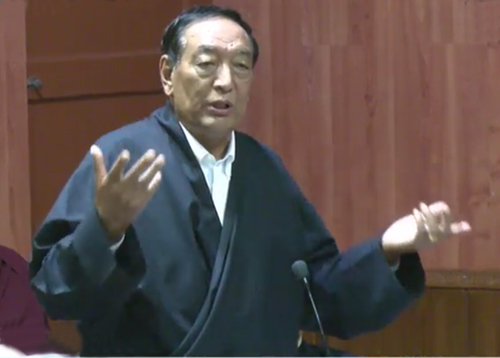
(Pema Chinnjor, the current kalon of the Chorig Lekhung, or minister of the Religion and Culture Department of the Central Tibetan Administration in exile)

Below is a translation I made of part of a recent article by Dondup Tashi that appeared on the Tibetan news site Tibettimes.net on the 25th of March 2016, which deals with concerns about the fact that the majority of students in the reconstituted Tibetan monasteries in exile are now not in fact ethnic Tibetans, but are Buddhists of Himalayan descent. While in recent decades sarjorpas, or new arrivals from Tibet (i.e. Tibetans typically born and raised in occupied Tibet, who have come to live in Tibetan exile communities more recently), have made up the primary demographic in the exile monasteries, things have now changed. Continue reading

“Doctor, there’s a Demon in my Drink!” Tibetan Grimoires and the Tibetan Medical Tradition


guru rinpoche beer spell tibetan grimoires

Padmasambhava (pictured above), the mythic tantric saint who ensured the flourishing of Buddhism in Tibet in the 8th century was both a fully realized being and a consummate sorcerer. He is credited with having tamed the unruly indigenous demons of Tibet and having helped establish the first Buddhist monastery on Tibetan soil. As Tibet’s ‘Second Buddha’ his cultural importance to Tibetans is hard to over-emphasize. This Lotus-Born Precious guru is the quintessential model for the non-celibate tantric practitioner or ngakpa. As a realized Buddha he is the practitioner’s own basic, pure and perfect nature, as a historical and cosmological figure he represents the model practitioner of the path of tantric Buddhism, the Secret Mantra Vehicle. In his dress, comportment, practices, activities, teachings, motivation, and view he embodies everything that the best tantric practitioner should be.

It is thus no surprise that Padmasambhava’s legendary activities should feature strongly in Tibetan magic. Compared to their counterparts in Western esotericism, Tibetan medico-magical practices, and Tibetan grimoires (ngak ki beubum, སྔགས་ཀྱི་བེའུ་བུམ) have received relatively little scholarly attention. This paucity of scholarly interest is perhaps exacerbated by the fact that the more spiritual dimensions of Sowa Rigpa, or Traditional Tibetan Medicine (TTM) have been formally excised from state-sponsored Sowa Rigpa curricula in contemporary China. Continue reading

So, You Want to be a Tantric Wizard, Huh?

so you want to be a tantric wizard


Part of my current PhD research focuses on the overlaps – and divergences – between ideas about what practicing tantra means in ‘traditional’ or ‘indigenous’ Asian contexts and in what can be called ‘neo’ or ‘New Age’ tantric settings.

Recently, I’ve been coming across a great number of (white) people who describe themselves as ‘Tantrikas’ and ‘Dakinis’, traditional terms for somebody following the path of (an often but not always non-celibate) tantric practitioner and vow-holder. The (often, but not always) white people who use these terms most liberally frequently seem to be operating well outside of the boundaries of traditional Indian or Tibetan tantra, that is, the native religious system of someone like His Holiness the Dalai Lama. As an anthropologist, I’m not interested in categorically dismissing or merely debunking these white self-avowed tantric masters and goddesses Continue reading

A Tibetan Ghost Story: How Three Chod-pas Tamed a Yakshini

chodpa

The following is a rough translation of a spooky Tibetan story that was shared on the popular Tibetan-medium site Khabdha. It tells the tale of three ngakpa – non-monastic, non-celibate tantric yogi sorcercers – who engage in the special exorcistic meditation of  Chöd, and end up encountering a very dangerous demoness (more specifically, a yakshini or alluring female nature spirit, associated with the granting of power, riches, and sickness). I hope you will read it and be careful the next time you are practicing yoga in the wilderness!

Besides being quite chilling and engaging, the story is also noteworthy for other reasons. It reminds us for one, how Tibetan Buddhist yoga is a lot more human thigh-bone trumpet and visions of demons than Lulu Lemon, coconut water and gym memberships, and points to the awe and fear with which the Tibetan practice of Chöd – particularly in its solitary, and itinerant iterations – continues to be held. As part of the Chöd (gcod) or ‘severance/cutting’ offering rite practitioners visit terrifying, haunted locations, where, through complex ritual choreographies of visualization, liturgy-singing, dancing, and drumming, they work with the energy of their fear of annihilation by meditatively disengaging from their body, severing their investment in a constructed self, and offering their ‘corpse’ up to be eaten by beneficent as well as  hungry, suffering demonic beings, which they have summoned. As I mention in another post about the practicegcod not only pacifies these demons – themselves ultimately displays of Mind and a product of self-grasping like all phenomena – but also powerfully severs the practitioner’s attachment to their self-importance and allows them to develop profound compassion, generosity and fearlessness.

The story below is noteworthy, however, for how it reminds us that just because spirits are empty, illusory displays from the vantage-pointless vantage-point of ultimate non-dual reality, that does not mean that they do not appear to be real at the conventional level, and do not act in the world of apparent phenomena (after all, your and my own sense of self is likewise an ultimately empty, illusory display but many people still take your and my actions in the world pretty seriously). Chöd (and the story below!) is thus interesting for how, on one level, it is a teaching about the ultimate non-reality of demons, of all those terrifying projections that haunt us, but on another, serves to demonstrate just how potent and devastating, how perilous, those demons can be. On a separate note, with its descriptions of the three brothers’ divvying up of familial and religious duties, the story that follows also provides some small insight into ngakpas’ time-management strategies, and the everyday familial, socio-economic dimensions of Tibetan yogic practice.

Here follows the translation:

A story of how three Chöd  practitioners tamed a Yakshini [i.e. a female ‘harm-giver’ or local land spirit (gnod sbyin mo)] – By Tenpé Nyima Continue reading