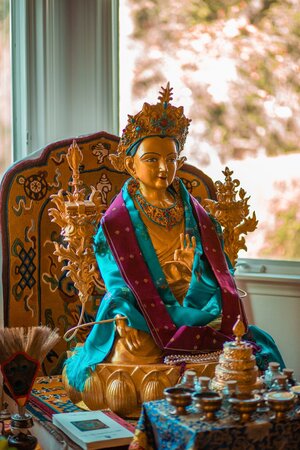
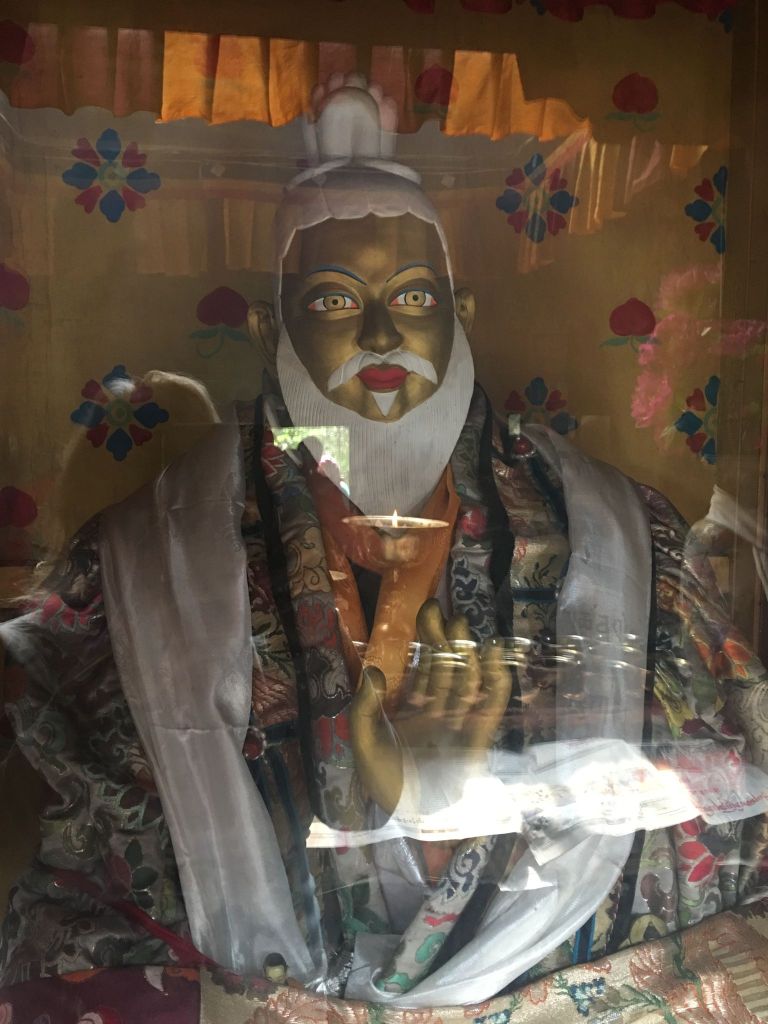
The statue of Yuthok the Younger at Yuthok Ling temple at Pure Land Farms, Topanga.
The Tibetan physician and tantric yogi Yuthok Yönten Gönpo is one of the most important figures in the history of Tibetan medicine or Sowa Rigpa, ‘The Science of Healing’ (Yuthok is pronounced a bit like the English words ‘you’ tock’. The th represents aspiration rather than a dipthong, so you should use a breathy tah sound as in the English word ‘top’, rather than a th sound like in ‘thought’ or ‘these’!). Born in or around 1126 in Western Tibet, Yuthok is one of Sowa Rigpa’s chief systematizers. He is widely regarded as the author of the Gyü Zhi or ‘Four Medical Tantras’, the four-volume Tibetan-language medical textbook which still holds pride of place in Tibetan medical curricula today. Yuthok’s influence on the history of Tibetan medicine is pervasive, so pervasive that there are two of him. Two key figures in Sowa Rigpa history share the name Yuthok Yönten Gönpo. The eleventh century Yuthok pictured above is referred to as Yuthok Sarma or ‘Yuthok the Younger’. Yuthok Nyingma or ‘Yuthok the Elder’, on the other hand, refers to a different hereditary doctor from the eighth century, who is said to be the biological ancestor of Yuthok the Younger. Yuthok the Younger is also understood to be Yuthok the Elder’s reincarnation. There is a close connection between these two figures and their life-stories often blur considerably. Both Yuthok the Younger and Elder are celebrated for their accomplishments in medicine and meditation. Both are remembered as having been consummate ngak-men or ‘tantric yogi-doctors’: individuals equally trained in medical science and tantric yoga and ritual. The biographies of both Yuthoks are hagiographies – in both his younger and older incarnation, Yuthok appears as both a highly-skilled physician and as a highly realized siddha, a tantric saint or adept capable of reading minds and performing miracles. Both Yuthoks are said to have achieved the ‘Rainbow Body’, to have dissolved into light upon their death.
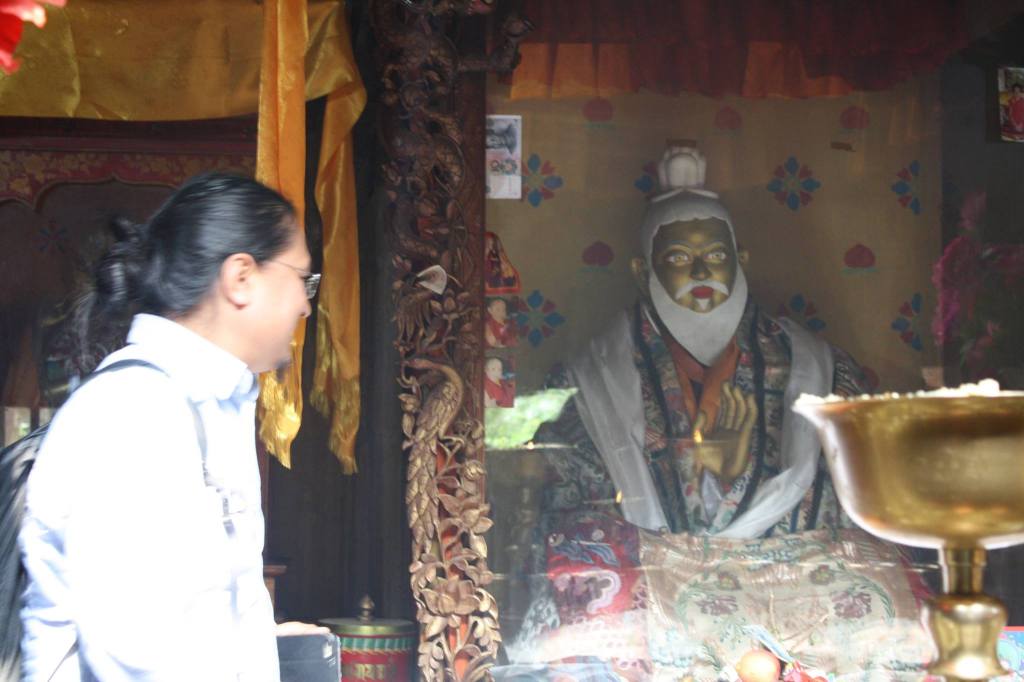
Dr Nida Chenagtsang beside a statue of Yuthok the Elder, located in a small renovated clinic associated with him built in 1996 in his Yuthok the Elder’s birthplace in Central Tibet. Photos taken in 2017, courtesy of Karen Stone.
While Yuthok the Younger is relatively well-attested as a historical figure, the status of Yuthok the Elder as a historical personage is more uncertain and contentious. In the past few decades, the historicity of the Elder Yuthok has received a lot of attention in Tibetan-language scholarship. The major source for information about the life of Yuthok the Elder is a namthar or spiritual biography about him which was put together and published in its current format by Darmo Menrampa Lopzang Chödrak (1638 – 1710) during the late 17th century. Respected, recently deceased Tibetan doctor and scholar Yangga has proposed that no evidence exists for a figure known as Yuthok the Elder prior to the 17th or 16th centuries. Darmo Menrampa states that he came into the possession of an outline of Yuthok the Elder’s biography penned by a descendant of Yuthok’s line, which he then developed into a fuller work. Yangga suggests that the Elder Yuthok’s biography is mostly based on elements of the Younger Yuthok’s life, which were then projected backwards in time. In his unpublished English-language doctoral dissertation, he notes that this backwards projection served to connect Yuthok the Younger’s life and lineage to the 8th century Tibetan imperial period, a high-point for centralized Buddhist authority and state patronage of doctors and medicine in Tibet:
“I would like to suggest that the biography of the Elder G.yu thog [Yuthok] was invented by a descendant of G.yu thog Yon tan mgon po in the fourteenth century or later, on the basis of G.yu thog Yon tan mgon po’s [Yuthok Yönten Gönpo’s] – i.e., the Younger G.yu thog’s — biography. It seems to me that the purpose in inventing this Elder ancestor of G.yu thog Yon tan mgon po was to show the importance of this lineage by creating a connection between their ancestor and the Tibetan emperor. In sum, it is unlikely that the biography of the Elder G.yu thog is a reliable source.” (2010, 96).
Scholars like Yangga may not find Yuthok the Elder’s biography to be a reliable source for actual events in the 8th century but it remains a fascinating piece of literature. Regardless of whether we treat Yuthok the Elder as a more mythic than historical figure, his biography is an interesting source of Tibetan representations about healing, medicine, and spiritual charisma, even if some of the historical details don’t quite bear out (see here for a book chapter by Yangga in which he lays out some of the contentious and inconsistent points in Yuthok the Elder’s hagiography. See here as well for a touching obituary and tribute to Yangga by Janet Gyatso). Yuthok the Elder and other key figures mentioned in his hagiography continue to play an important role in Tibetan medical traditions and worldviews as well.
In this post, I’d like to explore just one aspect of Yuthok’s life and history – his name. Yönten Gönpo (Gunanatha in Sanskrit, ‘Lord-protector of Enlightened Qualities’) is Yuthok’s personal name, but Yuthok or Yuthokpa – literally ‘the Turquoise Roof guy’, the name he is best known by – is a family title. Yuthok the Elder’s biography contains an extensive explanation of the origin of this title, and I’d like to explore it a little here. In his 2019 chapter on the biography, Yangga cites the account as one of several controversial points which suggest the biography is historically unreliable. In this case, he notes that both Yuthok the Elder and Yuthok the Younger are said in their biographies to have had a grandfather called Gyakar Benza or ‘India Vajra’ who first used the title Yuthok, and their stories are almost the same. This being so, it doesn’t really make sense that the title Yuthok would have been inaugurated twice, if Yuthok the Elder and Yuthok the Younger are from the same family-line. This suggests that Yuthok the Younger’s grandfather’s story may have been used as a basis for the more elaborate story in Yuthok the Elder’s biography about his own ancestor. In any case, here follows my translation of the section from Yuthok the Elder’s biography which addresses the question of how the title Yuthok emerged. I will translate it in full and then go on to highlight some points that are of interest, at least to me (for an alternative translation of this episode see pg. 183 – 185 of Ven. Rechung Rinpoche’s translation of the biography in his 1976 book ‘Tibetan Medicine’)
How Yuthok got his Name:
“From among Yuthok the Elder’s lineage ancestors, there was one who was renowned as a great learned master (khepa, མཁས་པ་) and whose name went from Drejé Gyakar Benza (‘Lord of Demons India Vajra’) to Yuthokpa (‘he with the Turquoise Roof’). Reasons are given for why he was called Yuthokpa, why he was called Drejé and why he was called Gyakar Benza. The reason he was called the first of these three names, Yuthokpa, is as follows:
At the time in question, this great saintly being [i.e, Drejé Gyakar Benza] was living in a place [in Tibet] called Tölung Kyina. Here he devoted himself to the welfare of patients and was never idle in this pursuit for even an instant, accumulating as he did vast oceans-worth of the Two Accumulations of Merit and Wisdom. One day, he was on his way to check in on a patient he had visited on his rounds previously, when an astonishingly beautiful woman appeared next to the great bridge of Tölung and requested that he, the great learned master, come to her place. The great learned one replied:
“I bow to the Vaidurya-Light Medicine Buddha – If I don’t return to the patient who I previously visited, I’ll transgress my doctor’s vows. If I don’t abide by my promises, My patient will despair and his mind will be disturbed, His care-givers will gossip and say I’m a bad person, And the Drangsong medical Sages and medical Vidyadharas* will punish me. Beautiful non-human spirit woman, Don’t be mad at me – run along now back home!”
*A Sanskrit technical term, the Tibetan translation is rigdzin, རིག་འཛིན་, literally ‘[up]holders or possessors of knowledge, typically esoteric knowledge’. Refers to highly accomplished human and non-human tantric-mantric sorcerers and siddhas. The word also sometimes read through the lens of Dzogchen to mean ‘those who continually maintain or possess rigpa, i.e. knowledge of the basic natural state, the nature of mind’.
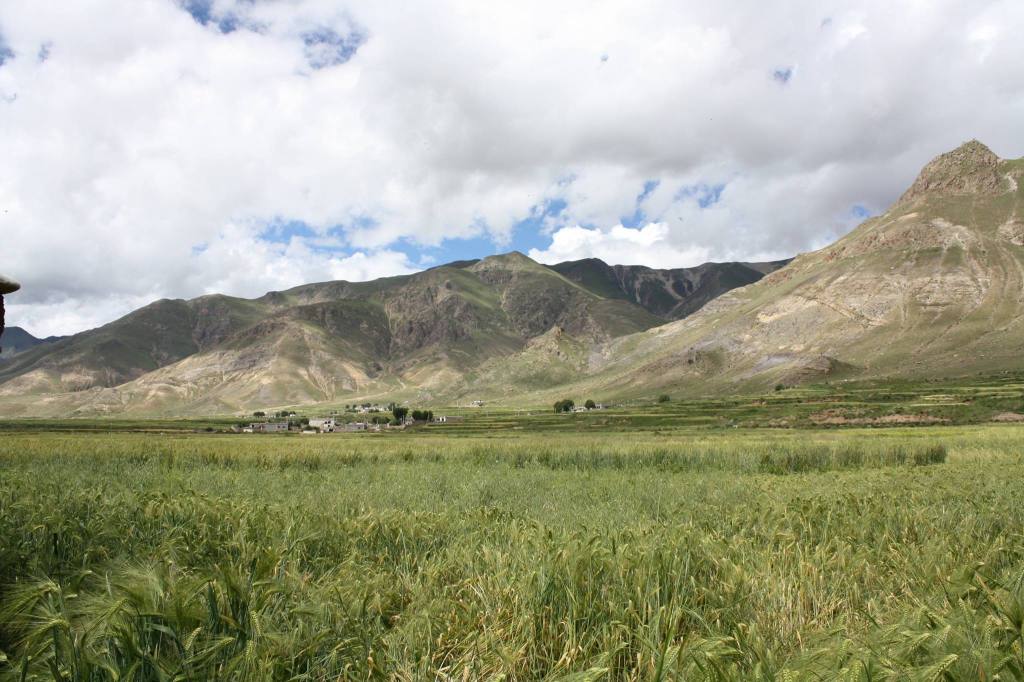
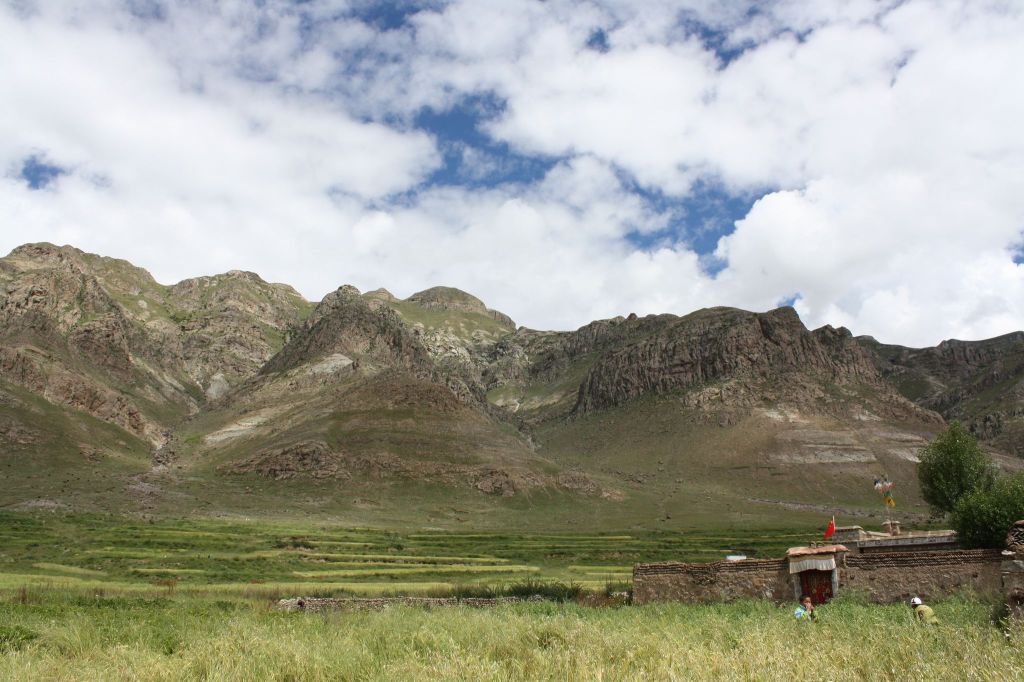
Images of Yuthok the Elder’s birthplace, Tölung Kyina in Central Tibet taken in 2017, courtesy of Karen Stone.
The spirit woman replied:
“Dharma-King of all Three Realms*, the one from Kyina, You are known by the name Dreltshé Dönden, ‘All those who encounter you benefit’, You possess Bodhicitta and bring all the Three Realms under your power, You realize Emptiness and subdue all beings of the Three Worlds with your splendour, Consummate Siddha, you make all the eight classes of spirits your servants, Your yidam or tantric meditation deities have taken you under their protection, siddhis, spiritual powers rain down upon you, You have become Lord of Deities, Demons, and Humans And so you are known as ‘Lhajé, Lord of Gods, Mijé, Lord of Humans, and Drejé, Lord of Demons. Understanding that all ‘mother-sentient beings’ are none other than your own parents, Your view is as all-pervasive and impartial as space! O You Great Holy Being, My Lord-Father who is a King among the Lü, the Naga water spirits, Is deeply unwell, laid low with a terrible disease. So, for the benefit of beings, please, I beseech you, come with me for a moment!”
*The Desire Realm, Form Realm, and Formless Realm, i.e. the entire universe.
The learned master Drejé, Lord of Demons, replied, “Where is your place?” “My place is the one up there,” she said. There was a black, rocky outcrop obscured by fog and shadow. “That’s very far away. We won’t reach there by nightfall. I’ll go tomorrow,” he said. “Walk on this bolt of silk,” the spirit woman said. As soon as he placed his feet on the bolt of white silk she had rolled out, they arrived in the midst of a place he had not seen before, a place with many people. Then there appeared a great castle on a cliff, with jutting walls. It was adorned with gold and turquoise and other such precious stones and contained an unimaginable array of sense-pleasing objects. In the centre of the castle was a black/dark-skinned ngakpa (i.e. tantric yogi sorcerer) with a topknot of dreadlocks as tall as a human man and a body as tall as three human men standing on top of each other’s shoulders. His body was stricken with disease and he was groaning and emitting various sounds of discomfort. At the pillow-side of his bed there was jewelled throne on top of which was soft cushioning of silk brocade sewn with multi-coloured thread. This was covered by a jewelled seat on top of which was a rug made from the skin of a black-skinned antelope. The great learned one, the Master of Demons, was invited to sit there. Once he’d done so, the ngakpa spoke as follows:
“Khetsün, learned and righteous one, greatest among Siddhas, The greatest medicine is that which eliminates pain from the body, The greatest doctor is the one who knows how to combine cooling and warming medicines, The greatest comfort comes from knowing how to make bandages and other things for wounds, The greatest expert is the one who knows how to distinguish hot-natured and cold-natured disorders, The greatest bringer of joy is pleasant words, The greatest and keenest intelligence comes from an undeluded mind! All who see you benefit, all who encounter you are led towards liberation, Protect this Lüdü, this Naga-mara demon, from the pain of sickness, I beseech you!”
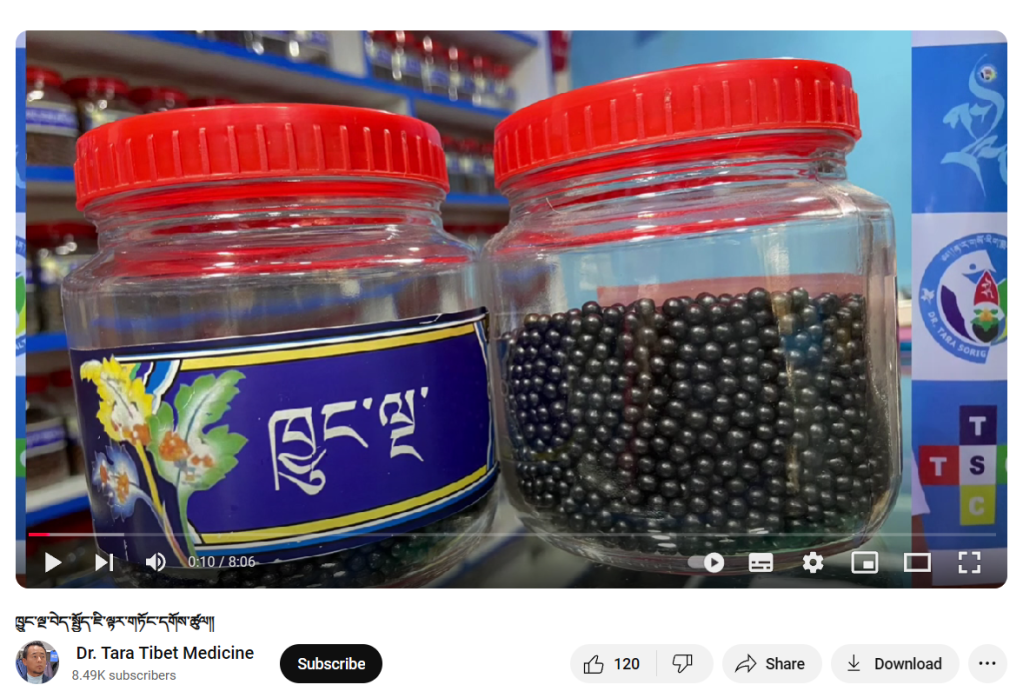
The great learned one responded: “From what causes and conditions did this disorder of yours arise?” The ngakpa replied, “I damaged the crops of a certain region and the sersungpa, the ngakpa there in charge of using magic to protect against hail, must certainly have struck me with his mantra-empowered mustard seeds (thün)”. “Alright then, show me your torso”, the learned one and Master of Demons told him. Some of the white mustard seeds had dissolved into his bone, some into his flesh, some into his skin, and some had absorbed into his blood vessels and nerves. Seeing this the learned master then administered Khyung Nga (Garuda 5), gave processed mercury internally and applied a gyenkhor (རྒྱན་འཁོར་) ointment externally. Through this, the Naga-mara was freed from his sickness in an instant. Then, the great learned one spoke as follows:
“You noxious, harmful Naga-mara! Your Father was a Mara and your Mother was a Nagini, In the past, you accumulated bad karma, negative actions, and obscurations, You took away the breath of beings, enjoyed consuming their life-force, In your future lives, you will be reborn in the three realms of negative rebirth*! Such compassion I have for you, o Black Naga-mara! Through the blessings of Medicine Buddha the King of Doctors And of all the Medical Sages and Vidyadharas, O Naga-mara Chief and all the beings you rule, May your harmful and coarse behaviours be pacified, May you have Bodhicitta, And may you all be reborn in Tanaduk*!”
*I.e. the animal, hungry spirit, and hell realms *The Medicine Buddha’s special Pure Land
Then, the Naga-mara and all his retinue became devoted to the Lord of Demons and offered their lives-and-hearts to him and agreed that they would now become friends of Medicine Buddha and all the lineages of the Medical Sages and Vidyadharas. They then offered him the Naga-mara’s countless substances and riches and in particular, his many wish-fulfilling jewels. Then Drejé placed his feet on the bolt of the silk which the beautiful woman who had previously invited him had unrolled and as soon as he did so, he arrived back at the end of the bridge. “I’m going to give you my own token of appreciation for your services as well,” the woman said, “so, come here to the end of the bridge tomorrow at this time.” She then magically transformed herself into a great, strong wind and dissolved into the mountain crags. He then called on his previous patient and returned to his home.
The great learned one thought to himself, “These gods and demons keep to their stipulations very strictly! I will go to the end of the bridge as she said”. Amidst great thunder, lightning, rain, and darkness a corpse of a woman bedecked from the waist upwards in gold and turquoise was carried by the river, circled around the bridge, and lodged there. The thought arose in the great learned master’s mind, “This must be the gift that she said she was going to give me.” “Such sin as this accrued on my behalf!” he thought and great compassion arose in him. Then he collected and saved the jewels and left the corpse in the river. He then laid out the gold and turquoise on the roof of his house. A shepherd saw the jewels and was heard to exclaim, “The learned master Thongwa Dönden has a turquoise roof!”. From then on, he was known as Yuthokpa, ‘the one with the turquoise roof’ (i.e. yu – turquoise; thok – roof).”
Mustard Seeds and Mustard Bullets: Animism and Other-than-Human Perspectives
There are many points of interest in the above account. Perhaps the most striking of these is the shifting of points-of-view we get to experience as the narrative unfolds. At the beginning of the story, we see things from India Vajra’s perspective. At first, for example, the spirit woman’s home looks like a dark, forbidding rocky outcrop many hours trek away from the bridge. Yet when the unnamed spirit-woman unrolls her bolt of silk and India Vajra steps onto it, time-space-and-perspective warp, bend, collapse and the doctor is immediately transported into another dimension, into a spirit-palace that is somehow inside or overlaid onto the regular human landscape but which also exceeds its contours and proportions. Within this other plane, India Vajra continues to perceive and interpret things through his human lens and categories but is brought into closer alignment with the point-of-view of the spirits themselves. The Nagini Princess’ ailing father appears to India Vajra in the guise of a human(ish) ngakpa or tantric yogi-sorcerer but is the size of three men. A few meters of rocky mountain contain, impossibly, a vast royal compound, brimming with untold treasures. Moreover, when India Vajra asks about what caused the Naga King’s affliction, the spirit explains that he was struck by the thün (ཐུན་) – white mustard seeds consecrated with forceful, exorcistic mantras – that were thrown by a human ngakpa specializing in hail prevention rituals (averting hail is one of the most important traditional services provided by village ngakpa in Tibetan and Himalayan societies – for more information about the liturgical and socio-economic dimensions of this sort of weather magic, see the excellent articles on these topics written by Ann Klein and Rdorje don grub). The physician then has the spirit reveal his torso and we see that the enchanted mustard seeds have lodged with devastating effect throughout the spirit’s body, like so much mantric buckshot. What may have looked like regular white mustard seeds to the average human observer of the weather-controller’s rites are experienced by the spirit as deadly projectiles. Assessing the extent of the damage, India Vajra then treats the Naga King, but not without scolding him in a song that urges him to take responsibility for the repercussions of his harmful actions and to forswear them henceforth.
This glimpse into human materiality from the point-of-view of spirits recalls the anthropological theory known as ‘perspectivism’. This concept was initially developed by Brazilian anthropologist Eduardo Viveiros de Castro, as an overarching lens for understanding various aspects of indigenous, Amerindian cosmologies and ways of being. The concept is part of the so-called ‘Ontological Turn’, an intellectual trend or movement under whose banner anthropologists have reappraised the older concept of ‘animism’ and considered the theoretical implications of the apparently radical notion that personhood, sentience, and consciousness might extend beyond human beings. Amerindian Perspectivism is based on the idea that humans, animals, spirits, and other non-human persons share a common ‘culture’, a shared capacity to adopt a conscious perspective and to enter into subject-subject relations. Researchers who study Tibetan, Himalayan, and Central Asian societies have applied Viveiros de Castro’s concept to their own field-sites which success – indeed, one could argue that perspectivism is dyed-in to the overarching worldview of Buddhism. Tibetan Buddhist texts drip with a deeply felt sense of the inconceivable vastness of the universe, of the ever-present realities of other lives and ways of being. The Buddhist ‘multi-verse’ is riddled with sentience, with alternative possibilities and perspectives co-existing and unfolding in a constantly shifting, impossibly vast web of interconnections, both latent and actualized, seen and unseen.
This dazzling array of lives and perspectives is not merely doctrinal or speculative, however, but is said to be based on the direct experience of meditators. In the tenth song from his Dzogchen Trekchö text (Khading Shoklab, མཁའ་ལྡིང་གཤོག་རླབས་, ‘The Flight or Flap of the Wings of the Garuda’), 19th century itinerant Tibetan yogi Shabkar Tsokdruk Rangdrol (1781 – 1851) addresses these ideas directly. Stressing the relativity of perceived phenomena, he points out how all concepts and perceptions arise of, through, and within Mind. In so doing, he gives us a glimpse of a vast and luminous Buddhist cosmos and outlines a Tibetan Buddhist version of perspectivism. The following is my rough translation of some portions of his song:
A painting of Shabkar Tsokdruk Rangdröl by Drugu Choegyal Rinpoche.
“Fortunate disciples, one and only children of my heart! All appearances are inconsistent. For some appearances arise, for some there is [merely] darkness. Further, there are some sentient beings on earth who perceive earth as earth, some who perceive earth as fire, some who perceive earth as their wealth or a resource to indulge in, some who perceive it as suffering. There are beings that perceive water as water, water as fire, water as nectar, water as their home, and water as earth. There are beings who perceive fire as fire, fire as riches, fire as a place to live, and fire as their food. Beings that perceive the sky or space as space, space as their home, and space as earth. Thus, since appearances are inconsistent it follows that things appear however they do due to the influence of [beings’] karmic imprints. In this way, the way we perceive each of the four elements is really just our human perception. Other beings perceive this earth as the fires of hell, the riches of the farmer, and as suffering caused by mental oppression. Likewise, fire-deities perceive fire as a resource, something they indulge in and enjoy, yidak or preta spirits with bodies made of fire perceive it as a home, and fire sinbu, invisible, microscopic creatures in fire, perceive it as food. In turn, beings in the hell-realms perceive water as fire, yidak beings perceive it as blood and pus, elephants perceive it as earth, deities as nectar. Deities [of the sixth heaven of the Desire Realm] with control over other’s magical emanations perceive it as jewels and rains of flowers and lü or naga spirits perceive it as their home. Space is also in the same way a home – all the deities perceive it as their earth. So it is that everything appears in accordance with however each individual being labels [or perceptually imputes] it…
… All the pleasures and pains of transmigrating beings in the six realms are created solely by their own minds. Rest your mind utterly in equanimity, having completely resolved for yourself that everything is non-existent yet appearing, is the natural form of Emptiness!
It is said that there are three thousand world-systems, universes upon universes, atop one single grain of pollen in the lotus [held in] Buddha Infinite Ocean’s hand. It is said that when one reaches the extent of rigpa, pure awareness, [facilitated by the Great Perfection practices of] Tögal, one perceives limitless Buddhas and pure lands in every pore of one’s body, and limitless abodes of sentient beings of the six realms, and further, that one can send out as many magical emanations to tame and benefit beings as one can in a dream.
Thus, all phenomena of samsara-nirvana are one’s own self-appearances. All these self-appearances are empty, without any basis. Develop confidence in the empty-and-luminous, ungraspable state. It is said, moreover, that in every tiny particle found within each atom there are immeasurable Buddhas and Pure Lands and innumerable abodes of the six classes of beings. The Victorious Buddhas have taught that all of these exist without getting mixed up together, without conflict, and without doing any harm to each other. Further, it is said that within the interior of every microorganism are innumerable cities of subsequent tiny organisms. It is said that there are multiple [heavenly] cities in the sky, formed facing downwards, crosswise, and upwards throughout the field of space, infinite cities [every which way]. When one wonders, ‘who made all of these like this?’, the Buddhas state that all are made by Mind…”
“…You now invite them and you present them with this torma cake and you tell them how beautiful and luscious [it is and request them to] please partake of it. And of course, some people in the West think, ‘Oh, the spirits are stupid! How can they be fooled by this? You know, you’re not [actually] offering them blood and flesh, you’re offering them [this] but – the spirits see what you’re visualizing. And you’ve done the ritual first with your meditation where you have called down and projected into the torma cake higher spiritual energies. You first cleanse the offering by sounding RAM YAM KHAM. [This is] where you visualize the wisdom fires evoked by [the Sanskrit mantra-syllable] RAM, the red wisdom-fires coming out of your heart chakra and burning away all the impurities on the torma cake. Secondly, you visualize the green wisdom-winds coming out of your heart chakra and blowing away all the ashes of the [incinerated, purified] torma cake. And finally, you visualize the white wisdom-waters coming out of your heart chakra and washing away any remaining impurities. So, this is the sangwa, the cleansing of your offering – in this case it’s the torma cake but it could be a whole series of offerings that you have on the altar in front of you.
Then, the second process of jangwa is purifying. [The offerings] have been cleansed now you purify them. Now, see, you are still seeing this torma cake with your impure, karmic vision. This is a vision you possess because karmically you’re a human being in this life so you see things the way humans do, you don’t see things the way a dog does, for example. But you know transform that impure karmic vision into pure vision, which is the way enlightened beings see things. And so you then close your eyes, which simulates a sensory deprivation experience or Shunyata, Emptiness. But Emptiness doesn’t mean nothing at all. Emptiness means the pure potentiality for all possible manifestations, like space itself. If you have something manifesting, there has to be space for it to manifest. So, you then visualize this magnificent torma cake – like one of these Western-world wedding cakes, seven stories high, and so on. And then so, this is then what the spirits will see.
And thirdly, you do that jinlap, that is, the calling down of higher spiritual energies and projecting them into the torma cake or the puja offering. So, when you sound OM AH HUM, where OM invokes the Enlightened Body aspect of all the Buddhas, AH invokes the Enlightened Speech Aspect of all the Buddhas, and HUM invokes the Mind aspect of all the Buddhas. And so, you’ve gone through all those three processes and then you have the proper offering for the spirits and then you call them and then you present it to them and you say, please feed off of this, and you see them gather around the torma cake, and their tongues come out and become like long tubes going into the torma cake and drawing up the juice or the nectar of the energy, the psychic energy which is projected into the cake. Because that’s what they’re feeding on. They’re not feeding upon the actual material of the roasted barley flour and vegetable dye, and this kind of thing. And then you say, now please be satisfied with this, now go away, return to your own places, and don’t cause us any problems in the future while we’re doing our practices.
But some of these spirits maybe aren’t satisfied. They’re recalcitrant, they’re kind of difficult and this [sort of thing]. So at that point, you have to manifest yourself as a wrathful deity and so you hold up in your right hand your dorje or vajra or else the three-bladed dagger known as a phurba and you show that to them and then you threaten them that if they don’t go away and don’t cease to cause problems then they will be smashed with this vajra or phurba and their heads will be crushed, and so on. So, then you have to have the mantrasiddhi to intimidate them and make them go away so that just be sitting there laughing at you [miming the spirits] – Ahahahahah!
Human and Spirit Medicines: Perspectivism and the Spirit Pharmacy
The medicines that India Vajra prescribes to the Naga King are fascinating to think about in terms of animist perspectivism as well. India Vajra gives the spirit medicines which are typically used to cure naga-related sicknesses in humans. Khyung Nga or Garuda 5 is a powerful antibiotic, antiviral, anti-parasite, painkiller formula made from five separate ingredients (processed aconite root – a highly poisonous herb; arura fruit, costus root, calamus root, and deer musk). The substance was traditionally used to cure leprosy, a disease especially associated with the retaliative actions of aggravated nagas (indeed, leprosy is often referred to as the ‘lü or naga disorder’). Each of the ingredients in Garuda Five are said to correspond to different parts of the mythical Garuda or Buddha Bird’s body, which it sacrificed upon its death to benefit beings beset by various maladies. Its flesh became arura (Terminalia chebula), its bones ruta (Dolomiaea costus), its tendons shudak (Acorus calamus), its heart tsenduk (Aconitum spp.), and its blood latsi or musk of Moschus moschiferus. The Four Medical Tantras of Tibetan medicine explain how Garuda Five pills should be placed in a mandala and consecrated via Garuda mantras and visualizations.
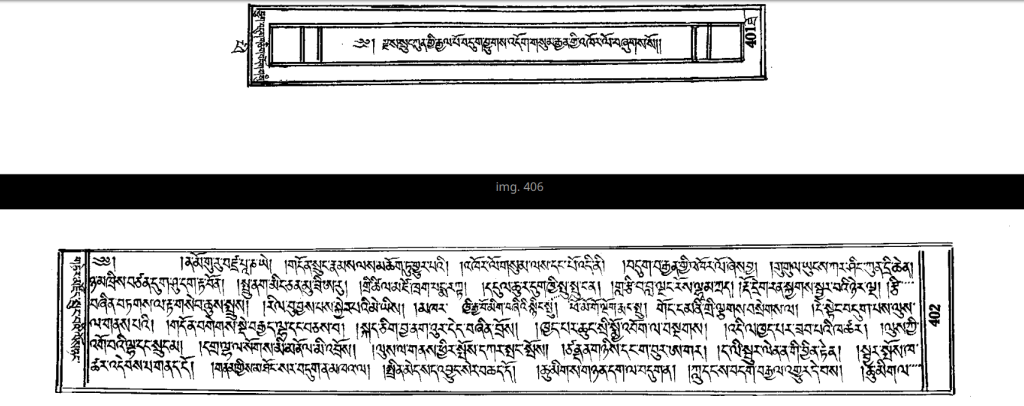
We also learn that Indian Vajra applied gyenkhor ointment to the spirit King’s wounds. This is yet another example of a powerful medicine which is typically used by humans to banish harmful spirits being used on a spirit to heal harm inflicted by humans. This medical-magical formula comes from the terma or revealed ‘Treasure’ tradition. Gyenkhor or gyen ki khorlo means ‘the ornament wheel’ or mandala. The formula, which is an example of dze sung, རྫས་སྲུང་ ‘protection via ritual substances’, has three ‘wheels’ or applications: it can be used as a fumigating incense, as an ointment, or pills of the formula can be carried close to the body. A terma text revealed by the great tantric visionary Nyangrel Nyima Wözer (1124 – 1192), included in the Precious Treasury of Terma Teachings or Rinchen Terdzö, explains that the formula is made out of twenty-five potent animal, mineral, and vegetable ingredients, which together serve as one of the best protections against all kinds of dön and gek or harmful spirit influences and obstructions that there is (each of the three applications have slightly different combinations of twenty-five ingredients and extra supplementary substances). It is interesting to think of India Vajra’s treatments as a kind of spirt homeopathy, where the same formulas which are noxious to spirits can, in their domain, cure harm caused by similar substances.
An excerpt from Nyangrel Nyima Wözer’s text about the gyenkhor twenty-five ingredients protective formula.
Hybrid Beings: Perspectivism in the context of Spirit Taxonomies
We can see a hint of perspectivism in the moments in the story when the spirits talk about their own ancestry. India Vajra notes, for example, that the ailing spirit King is the son of Also the idea of spirit taxonomies – Indian Vajra notes that the ailing spirit chief is the son of a mara demon or düd བདུད་ father and a naga or nagini, lü[mo] ཀླུ་མོ་ mother. These kinds of hybrid spirit categorizations are quite common in Tibetan contexts and seem to go back to pre-Buddhist Bönpo traditions. They speak to a certain fluidity and miscegenation among spirits, a topic I explore briefly in an older post about categorizing Tibetan worldly spirits. I can’t claim to know about how spirit dating and family structures work, but it is interesting to wonder about how human conceptions of types of spirits may or may not have currency for spirits themselves.
A Cursed Gift? Perspectivism in light of the Nagini Princess’ Thank You Gift
There are a number of vivid scenes in this story, but the original Yuthok’s dismay at realizing that the grateful spirit Princess may have killed a human just for his benefit stands out in particular. One imagines the spirit churning up the waters it governs, kind of turning her ‘handbag’ inside out and dumping out its contents, with a ‘Hmm, do I have anything good in here a human might like?’ It is not clear in the account who the dead woman is – she is never specifically identified and it’s not clear from the account whether she was the victim of a drowning previously and the spirit just sent her to the ngakpa-doctor so he could grab her jewels, or whether she was purposefully killed by the spirit to give as an offering. Indian Vajra himself seems disturbed by the ambiguity as he reflects on the potential negative karma the otherwise well-meaning spirit may have accrued through the action, with the same mix of emotions that typically flash through cat-owners’ hearts as their demonic serial killer pets dump yet another headless bird corpse at the foot of their beds unexpectedly. In this case at least, India Vajra accepts the riches and endeavours to do something with them. We are told specifically that he left the corpse in the river. It’s not clear why he didn’t move the corpse as well or do rites on the deceased woman’s behalf, but one gets the sense that perhaps he may have understood that the body had already been claimed by the river and its spirits, was already their property.
Parallel Accounts: Yuthok the Elder cures a Nagini Queen
Spirits travelling to see Yuthok and begging for his help as a doctor, specifically to heal their ailing relatives, is a recurrent theme in the various biographical materials we have for both Yuthoks. While the details change slightly, the idea that Yuthok and his ancestors were spirit-doctors is consistent. An abbreviated version of the account above involving Yuthok’s ancestor Drejé/Indian Vajra is citied by Zurkharwa Lodrö Gyalpo (1509 – 1579) in his khokbup or essential digest of biographical information concerning noteworthy doctors. He notes that the figure known as Gyakar Dorje “studied with many Indian and Tibetan scholar-practitioners and in that way became learned in the various sciences in general and in Sowa Rigpa in particular”. He explains that at one time, this figure, “served as a doctor to a zhibdak (i.e. a local land spirit) who lived in Gyarak Kawatrang and was given the corpse of a woman richly adorned in turquoise jewelry as a gift or reward in appreciation for his services. He dried the turquoise jewels on the roof of his house and through that he came to be known as Yuthokpa”.
This is the barebones of the store, then, which was either more extensive in oral tradition or the family manuscript given to Darmo Menrampa or was embellished further by Darmo Menrampa when he developed the above biography. The story of Yuthok’s ‘Master of Demons’ ancestor appears again in the biography of Yuthok the Younger, where the spirit in question is described as a dré (a ghost or demon). The account is thus duplicated – both Yuthok the Elder and the Younger are said to have had an ancestor who was called ‘Master of Demons’ and who received turquoise ornaments from a corpse after healing an ailing spirit, yet the details about where this took place and about whether these events happened to two separate ancestors or the same single ancestor is blurry – yet another indication of how Yuthok the Younger and Yuthok the Elder’s biographies overlap. Later on in Yuthok the Elder’s biography, we read about how Yuthok the Elder himself also healed a spirit. The details of this account echo ones in the story of Indian Vajra as well. Here is my translation of the episode:
“Then, amid crowds of innumerable monks and disciples, the Great Yuthok spent his days spreading the teachings, through the three activities of expounding, debating, and writing. During the night, he meditated, resting in equipoise in a deep state of samadhi or meditative absorption. Tirelessly and without distraction, he worked day-and-night for the vast benefit of sick patients. At one point during this period, a woman appeared. She had the upper body of a human and the lower body of a snake and the crown of her head was adorned with a precious wang gi gyalpo, ‘King of Power’ wish-fulfilling jewel. “I offer this jewel to the great being Yuthok Gönpo, who visited India three times. My older sister is sick, so please come to my land,” she said, and then prostrated to and circumambulated him.
Great Yuthok answered, “Where is your land? What is your name?”. “I am from the Land of the Lü (Nagas). Of us three sisters, my oldest sister is Queen Taduk Tongga (‘Beautiful to Behold, Pleasing to See’), the sister below her is Taduk Tonglek (‘Beautiful to Behold, Good to See’), and I am the sister below her, Taduk Tongdzé (‘Beautiful to Behold, Lovely to See’). My sister Taduk Tongga’s body is in great pain, so I humbly request that you come right now.” Great Yuthok answered, “What work do you three sisters do, what sort of activities do you engage in?” “We three sisters are all queen-consorts to the Naga King. We serve as attendants to the Naga King. We make offerings to the Buddha Lüwang gi Gyalpo, ‘King of Power over Nagas’ and work to suppress nagas who are harmful or unruly.” Great Yuthok replied, “I am not a lhajé, a personal physician to you royal naga-sisters or a lüjé, a physician for nagas in general. I will not come. I haven’t verified your background and the land you come from, so listen carefully to this song!”:
“Homage to the Drangsong Sages, Who possess the five Buddha-eyes and six types of clairvoyance*! I, the learned one Yuthok Gönpo, Heal the bodies of humans, highest and chief among beings, I am the doctor who keeps them alive. You nagas only know how to cling to viciousness and coarseness, you don’t know how to give these up! You sleep your wretched corpse-sleep of ignorance, You are in the class of animals, stupid and deluded! I will not come and be your your Naga Physician – Taduk Tongdzé, run along now back to your own land!”
*The jen nga (སྤྱན་ལྔ་) are the material eye of flesh, the divine eye of the deities, the eye of sherap or wisdom, the eye of Dharma, and the eye of yeshé, ever-present knowing. The six types of ngönshé, ‘clairvoyance’ or ‘direct perception’ are: direct perception involved in performing miracles; divine sight; divine hearing; understanding other’s minds; knowledge of the past and future; and knowledge of the dissolution of all corruptible phenomena.
The Nagini replied,
“Heart-son of Medicine Buddha, King of Doctors, Your enlightened activities perfectly accomplished, you multiple benefit for beings, To you who are so well-known as Yuthokpa, To Yönten Gönpo, I prostrate and pay homage! You are jé, Master to deities, demons, and humans, Thus you are known as Lhajé, Mijé, Drejé – Master of Deities, Humans, and Demons. Save the Naga Queen from sickness, You are Yönten Gönpo, Lüjé, the Master and Physician of Nagas! Regardless of how noxious the race of nagas may be, There is no reason at all they would seek to do their Great Master harm. Don’t say you won’t come, come quickly! Please, do it as a great help and favour to Taduk Tongdzé, Come on behalf of Nagini Tongga!”
Having made her request, she unfastened the jewel from her crown and offered it to Great Yuthok. Then Yuthok said, “I will help the naga-woman Tongga and go with you to the Land of the Nagas. Nagini Tongdzé, you must show me the way.” She offered him a white silver mirror with all sorts of precious jewels in-laid on it and said, “Khepa chenpo, great learned one – Look into this!”. He looked as instructed and as soon as he did, he arrived at a lovely Naga Palace, beautiful to behold and filled with everything one could need or desire. Then, he saw a beautiful and captivating naga-woman whose body was struck down by sickness and who was groaning with a dir dir sound like the buzzing of bees. By the pillow at the head of her bed was a great, wide jewelled throne, on top of which were nine [or multiple] soft cushions of silk brocade sewn with multicoloured thread, piled on top of each other, on top of which was a throne-covering made from the skin of a black antelope. Great Yuthok was invited to sit on this tenth tier. The naga-woman Taduk entreated him as follows:
“Jé, Master, Gönpo, Lord-Protector of beings with human form, To Yuthok Gön I prostrate and pay homage! I am the Nagini Taduk Tongga – Through the magical power of ngakpa not having preserved their tantric vows, Monks not having maintained their monastic vows*, Lay people having broken their oaths, Women having had sex and not having preserved their bodies, And yogis having enaged in inappropriate, immoral conduct, The eight classes of noxious deities and demons have grown angry, The vapour of their breath has accumulated like fog and clouds, And has manifested as disease, as the naga sicknesses pöl dré*, As the pain of gak lhok, and as muchu*, As the spread of hala jokgyel in particular, Which does not pass after six or seven days*. If you free me from my own sickness, The humans will be freed from theirs – So I beseech you, grant me refuge from my sickness!”
*The verb chalwa (འཆལ་བ་) implies especially that monks have failed to maintain their vows of celibacy. *Skin rashes, eruptions, and cancerous growths *Gak lhok, contagious disorders involving throat and muscle inflammation, muchu, serious edema *This disorder is a little unclear – hala means ‘poison, poison’ and gyel means to ‘faint’.
Great Yuthok washed the naga-woman Taduk Tongga’s body with saffron-infused water. He offered chap tor orwater offerings and lü tor, naga torma or offering cakes, inserted lü ter or naga treasure substances [into the earth etc.] and performed and bestowed mendrup empowerment ceremonies for realizing medicine as nectar. He gave the Nagini detoxified mercury and precious metal and stone formulas to take internally and through this the naga-woman was freed from her disease. The Lady Taduk Tongga gave him a parasol made of turquoise. The Lady Taduk Tonglek gave him a wish-granting jewel. Lady Taduk Tongdzé gave him jewel which would grant whatever he needed or wished when he prayed for it. The Naga King gave him a golden nine-pronged dorjé or vajra eight fingers’ breadths in length and all sorts of other specific precious jewels beyond count. Then, Great Yuthok gazed into the mirror that the Lady Taduk Tongdzé had given him and as soon as he did, he arrived back at his own home.
After that, anywhere that Great Yuthok would sit or stay, he would use the turquoise parasol to cover him where he sat and so he was known as Yuthokpa Yüdungchen, ‘Yuthok with the Turquoise Parasol’. As soon as he placed the wish-granting jewel on top of any being’s head he could see all their external and internal diseases clearly, so he was known as Menla Nyipa Yuthokpa, ‘Yuthok the Second Medicine Buddha’. When he prayed just once over the other jewel, all his wishes were accomplished, so he became known as Norlha Yuthokpa, ‘Yuthok the Wealth God’. Merely through displaying the golden vajra, all demons and provocations fled and so he became known as Trogyel Yuthokpa, ‘Yuthok, King of the Wrathful Deities’. As soon as he looked into the melong or ritual mirror, he arrived at whatever location he desired, so he became known as Druptop Yuthokpa, ‘Yuthok the Siddha’.”
Let’s compare the accounts then. Like his ancestor India Vajra, Yuthok the Elder is initially not so inclined to accommodate the spirit who comes seeking aid. Whereas Indian Vajra’s objection is that helping the spirit-woman will be too much of a time-consuming detour from seeing his human patients, Yuthok the Elder is considerably brusquer – he explains that lü or nagas are categorically not to be trusted, as a species, as a whole type or class of being (rik, རིགས་), and he states that he has neither the means nor the desire to serve as a doctor to them. He is more suspicious than his ancestor, saying that he cannot verify (literally ‘cut to or determine the origin or source’, khung chö, ཁུངས་ཆོད་) of the Naga Queen’s homeland and stresses that he is a doctor to human beings. In traditional Buddhist understanding, a human rebirth is especially valued because of the unique blend of suffering and advantage that form of rebirth provides. For this reason, humans are sometimes referred to as ‘supreme’ or ‘best’ among transmigrating beings subject to karma and rebirth (broadly speaking, there are six realms or dimensions of rebirth in traditional Buddhist cosmology: three realms of better or higher rebirth, rebirth as a deva (celestial deity), asura (demi-god or ‘Titan’), or human and three lower, negative rebirth possibilities, i.e. rebirth as an animal, hungry spirit, or in various hell-realms. Human incarnation constitutes a sort of ‘Goldilocks’ perspective within this spectrum of possibilities).
Yuthok the Elder initially rebuffs and scolds the Naga Queen. He tells her that she and her kind are all too attached to viciousness, maliciousness (duk, གདུག་) and ‘coarseness’ or ‘cruelty’ (tsup, རྩུབ་ – harshness, malintent, savageness, and so on). He notes that nagas are a type of animal. Animals are often depicted as being governed by confusion, ignorance, fear, and delusion. The lot of animal rebirth is unfortunate because animals do not have the capacities or opportunities to practice Dharma – as prey they spend much of their time fearing or fleeing from predation, as predators they cannot help but follow their instincts to hunt and kill. Yuthok dismisses the Naga Queen in a strikingly impolite way. Nagas continue to harm humans and refuse to change their ways. They are mired in a ‘corpse-sleep’ of ignorance, they remain blindly governed by their impulses. Even so, the Naga Queen is undaunted by Yuthok’s dismissal. Even if nagas are malevolent, what reason would they have to harm him, a Master of Spirits? In her responses the Queen seems to assume that Yuthok’s suspicion comes from a concern that the nagas might trick or harm him, whereas Yuthok’s refusal seems to have more to do with his feeling that nagas are too inveterate to divert his focus on. Significantly, the Queen reminds Yuthok of his lineage, invoking the triple title (‘Master of Deities, Demons, and Humans’) that was given to Indian Vajra. Yuthok must surely help her and her family, since the very advent of the ‘Yuthok’ lineage is based on this sort of human-to-spirit aid. In addition, the Queen assures Yuthok that she and her sisters are within the retinue of a Naga-taming Budda and work to suppress the harmful actions of more malicious nagas.
In this second account we see similar examples of perspectivism (what looks like a two-dimensional mirror from an ordinary human perspective is in fact a doorway into other worlds etc.). In this instance, in addition to precious metal medicines for internal use, Yuthok heals the Elder Naga Queen by giving her various offerings directly in her dimension, which humans typically offer to nagas while in human time-space-and-perspective, i.e. water and torma offering cakes, naga treasure vases, vessels which contain precious, auspicious, and medicinal substances which are buried in the earth or deposited in lakes as redress and repayment for the naga-governed natural resources so relentlessly extracted from out the ground, rivers, seas, and so on. Yuthok also performs a mendrup rite, a tantric empowerment ceremony to turn medicines into immortal nectar and bestows the empowerment on the Naga Queen. These offerings, initiations, as well as the saffron bath and formulas he prescribes cure the spirit-ruler.
The cause of the Queen’s affliction is especially noteworthy. In the India Vajra account, the spirit-sorcerer becomes ill due to a direct magical attack by a human sorcerer, a conscious act of ritual aggression in retaliation for the spirit’s own hostilities. In the case of the more benevolent Queen, it is the careless, immoral conduct of humans, largely ignorant of her existence, which makes her sick. Humans’ failure to maintain religious vows and social contracts, to uphold ritual taboos, maintain peace and harmony within communities and to refrain from killing other creatures and exploting and polluting natural resources ultimately disturbs and angers goddesses associated with the flourishing of natural ecosystems. The human sickness of selfishness and immorality literally sickens and weakens the non-human beings who own and govern, and who in some sense are the living intelligence of natural resources. This concept of the interconnectedness of spirits and humans is explained in the third volume of the Four Medical Tantras, in the chapter on rim né or contagious, epidemic diseases:
“The primary causes and secondary conditions for disorders known as ‘rim’ (རིམས་) are as follows:
When the time of the final five hundred years [before the Buddha’s teachings will disappear from the world] comes to pass, humans will engage in wrong conduct due to desire and craving. Ngakpa will increasingly act violently or commit murder within their own Vajra families of co-initiates, monks in the monastic sangha will engage in institutional, community disputes, non-Buddhist practitioners [like sadhus etc.], Buddhist monks, and Bönpo specialists will throw zor at one another [i.e. engage in aggressive magical warfare]. Laypeople will break their oaths, pollute their hearths, and slaughter animals. During this time, all the mamo and khandromas [i.e. Matrikas and Dakinis] will be disturbed. The sickness-inducing vapour of their breath will accumulate like clouds and from this bel né – ‘Nepali disease’, a contagious, fever-inducing disease – gyüzer, sharp intestinal pain disorders like dysentry, gak lhok, contagious infections causing throat and muscle inflammation, and drum nak or smallpox will arise.”
The Queen’s own account of her situation thus mirrors the Four Medical Tantras own explanations for how devastating epidemics arise. While these etiologies may appear fanciful, they are in fact closely aligned with contemporary biomedical understandings of epidemics. Human contact with displaced wild animals or domesticated animals as part of mass animal agriculture is the cause of all major pandemics, where viruses and other pathogens jump from animal to human hosts. Nature goddesses like mamo, khandroma, and nödjinma or yakshinis are often represented in Tibetan art as holding trays or bowls of food and medicines or jewels in one hand and so-called nekyel or ‘bags of diseases’ in the other. These are pouches of human or animal skin which contain rotting organs and all kinds of infectious, epidemic diseases. When we remain in right relationship with these goddesses, we can, on the one hand enjoy their bounties, but when disturb and sicken them through mindless, selfish behavior like deforestation, mining, war, pollution of air, water, and soil, excessive hunting and mass agriculture they can open their bags and send out these pathogens as their weapons, in acts of retaliative germ warfare.
A depiction of the Great Queen of Yakshinis and Matrika goddesses, Dönkün Drupma, the wife of Shanglön, the chief protector deity of Tibetan medicine. She carries a bag of disease and pathogens in her right hand as explained. Painting by Anna Artemyeva.
These tales of various Yuthokpas playing doctor to spirits are colourful and engaging. They provide information about the history and historiography of Tibetan medicine, but more than this, they give us insights into broader cosmologies, help us understand how Tibetans have thought about the vital interrelationship between humans, nature, and non-human beings. These understandings inform Buddhist and Sowa Rigpa concepts of well-being. There’s a lot more I could say about the pivotal role that reciprocity between religious specialists and land spirits has played in the development of Buddhism. I am of the mind that it would be entirely possible – and instructive – to write a history of Buddhism from the perspective of nagas, naginis, yakshas, and yakshinis, and other spirits. Scholars like Robert Decaroli and much more recently Adeana McNicholl have done some really great research along these lines, but there’s far more research to be done. I’ll leave it here though with the hope that these musings were interesting and with a final reminder to not look a gift corpse in the mouth.








 A Perfumed Skull